“We don’t call for people to vote, nor do we call for them not to vote. It just doesn’t interest us. What’s more, it doesn’t worry us. What interests us as Zapatistas is knowing how to resist and confront the many heads of the capitalist system that exploits us, represses us, disappears us, and steals from us.”
“Everywhere, these representatives of the “radical” left end up supporting neoliberal policies. Do we need, then, to form “truly” radical parties, parties that will not founder in such swamps? Or are the reasons for these “betrayals” structural; does every instance of participation in politics inevitably lead to surrender to the market and its laws, regardless of any subjective intentions to the contrary?”
“In order to grasp the dynamic that drives the global civil war, we first have to see the relation between the icy wind of financial abstraction and the reaction of the aggressive body of society separated from its brain.”
“Here is the danger of not going far enough in critical analyses of the system. Only if one sees clearly that there is no way out of persistent stagnation can one in fact become strong enough to win the moral and political struggle. One prong of the fork stands for the replacement of capitalism by another system that will be as bad or even worse, retaining the crucial features of hierarchy, exploitation, and polarization. The other prong stands for a new system that is relatively egalitarian and relatively democratic.”
“It is easy to explain the post-2008 urban investment surge as ‘more of the same’… But an examination of the current trends shows some significant differences and points to a whole new phase in the character and logics of foreign and national corporate acquisitions… We are witnessing an unusually large scale of corporate buying of whole pieces of cities in the last few years.”
Saskia Sassen: Who owns our cities – and why this urban takeover should concern us all
This article was originally published Nov 24, 2015 in The Guardian.
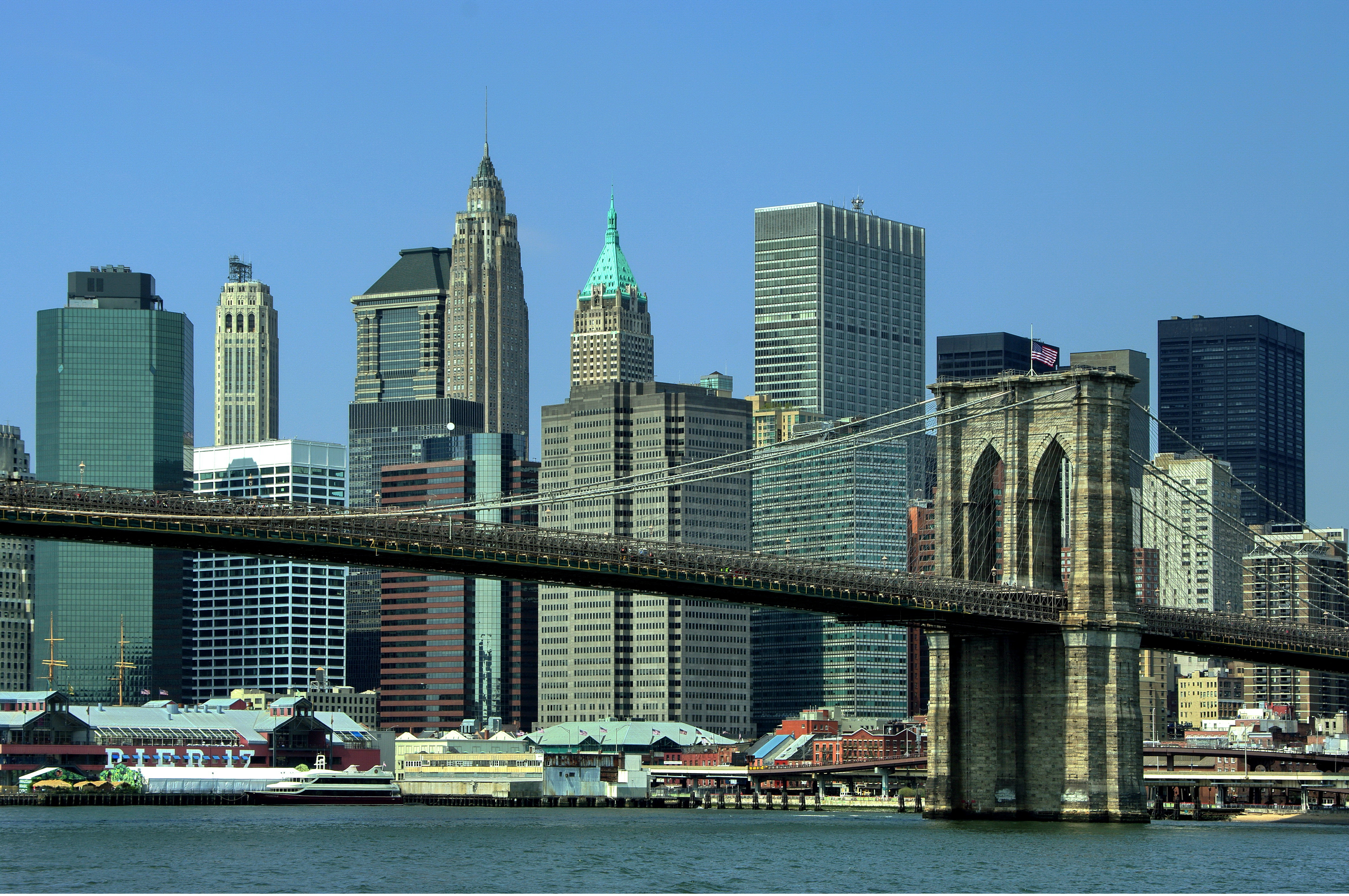
Brooklyn Bridge. By Dr.G.Schmitz (Own work) [CC BY-SA 3.0 (http://creativecommons.org/licenses/by-sa/3.0)], via Wikimedia Commons
Does the massive foreign and national corporate buying of urban buildings and land that took off after the 2008 crisis signal an emergent new phase in major cities? From mid-2013 to mid-2014, corporate buying of existing properties exceeded $600bn (£395bn) in the top 100 recipient cities, and $1trillion a year later – and this figure includes only major acquisitions (eg. a minimum of $5m in the case of New York City).
I want to examine the details of this large corporate investment surge, and why it matters. Cities are the spaces where those without power get to make a history and a culture, thereby making their powerlessness complex. If the current large-scale buying continues, we will lose this type of making that has given our cities their cosmopolitanism.
Indeed, at the current scale of acquisitions, we are seeing a systemic transformation in the pattern of land ownership in cities: one that alters the historic meaning of the city. Such a transformation has deep and significant implications for equity, democracy and rights.
A city is a complex but incomplete system: in this mix lies the capacity of cities across histories and geographies to outlive far more powerful, but fully formalised, systems – from large corporations to national governments. London, Beijing, Cairo, New York, Johannesburg and Bangkok – to name but a few – have all outlived multiple types of rulers and of businesses.
In this mix of complexity and incompleteness lies the possibility for those without power to assert “we are here” and “this is also our city”. Or, as the legendary statement by the fighting poor in Latin American cities puts it, “Estamos presentes”: we are present, we are not asking for money, we are just letting you know that this is also our city.
It is in cities to a large extent where the powerless have left their imprint – cultural, economic, social: mostly in their own neighbourhoods, but eventually these can spread to a vaster urban zone as “ethnic” food, music, therapies and more.
All of this cannot happen in a business park, regardless of its density – they are privately controlled spaces where low-wage workers can work, but not “make”. Nor can this happen in the world’s increasingly militarised plantations and mines. It is only in cities where that possibility of gaining complexity in one’s powerlessness can happen – because nothing can fully control such a diversity of people and engagements.
Those with power to some extent do not want to be bothered by the poor, so the model is often to abandon them to their own devices. In some cities (for example, in the US and Brazil) there is extreme violence by police. Yet this can often become a public issue, which is perhaps a first step in the longer trajectories of gaining at least some rights. It is in cities where so many of the struggles for vindications have taken place, and have, in the long run, partly succeeded.
But it is this possibility – the capacity to make a history, a culture and so much more – that is today threatened by the surge in large-scale corporate re-development of cities.
A new phase
It is easy to explain the post-2008 urban investment surge as “more of the same”. After all, the late 1980s also saw rapid growth of national and foreign buying of office buildings and hotels, especially in New York and London. In The Global City, I wrote about the large share of buildings in the City of London that were foreign-owned at the height of that phase.Financial firms from countries as diverse as Japan and the Netherlands found they needed a strong foothold in London’s City to access continental European capital and markets.
But an examination of the current trends shows some significant differences and points to a whole new phase in the character and logics of foreign and national corporate acquisitions. (I do not see much of a difference in terms of the urban impact between national and foreign investment. The key fact here is that both are corporate and large scale.) Four features stand out:
•The sharp scale-up in the buying of buildings, even in cities that have long been the object of such investments, notably NY and London. For instance, the Chinese have most recently emerged as major buyers in cities such as London and New York. Today there are about 100 cities worldwide that have become significant destinations for such acquisitions – foreign corporate buying of properties from 2013 to 2014 grew by 248% in Amsterdam/Randstadt, 180% in Madrid and 475% in Nanjing. In contrast, the growth rate was relatively lower for the major cities in each region: 68.5% for New York, 37.6% for London, and 160.8% for Beijing.
• The extent of new construction. The rapid-growth period of the 1980s and 90s was often about acquiring buildings – notably high-end Harrods in London, and Sachs Fifth Avenue and the Rockefeller Center in New York. In the post-2008 period, much buying of buildings is to destroy them and replace them with far taller, far more corporate and luxurious types of buildings – basically, luxury offices and luxury apartments.
•The spread of mega-projects with vast footprints that inevitably kill much urban tissue: little streets and squares, density of street-level shops and modest offices, and so on. These megaprojects raise the density of the city, but they actually de-urbanise it – and thereby bring to the fore the fact, easily overlooked in much commentary about cities, that density is not enough to have a city.
•The foreclosing on modest properties owned by modest-income households. This has reached catastrophic levels in the US, with Federal Reserve data showing that more than 14 million households have lost their homes from 2006 to 2014. One outcome is a significant amount of empty or under-occupied urban land, at least some of which is likely to be “re-developed”.
A further striking feature of this period is the acquisition of whole blocks of underutilised or dead industrial land for site development. Here, the prices paid by buyers can get very high. One example is the acquisition of Atlantic Yards, a vast stretch of land in New York City by one of the largest Chinese building companies for $5bn. Currently, this land is occupied by a mixture of modest factories and industrial services, modest neighbourhoods, and artists’ studios and venues that have been pushed out of lower Manhattan by large-scale developments of high-rise apartment buildings.
This very urban mix of occupants will be thrown out and replaced by 14 formidable luxury residential towers – a sharp growth of density that actually has the effect of de-urbanising that space. It will be a sort of de facto “gated” space with lots of people; not the dense mix of uses and types of people we think of as “urban”. This type of development is taking off in many cities – mostly with virtual walls, but sometimes also with real ones. I would argue that with this type of development, the virtual and the actual walls have similar impacts on de-urbanising pieces of a city.
The scale and the character of these investments are captured in the vast amounts spent on buying urban properties and land. Those global, corporate investments of $600bn from mid-2013 to mid-2014, and over 1tn from mid-2014 to mid 2015, were just to acquire existing buildings. The figure excludes site development, another major trend.
This proliferating urban gigantism has been strengthened and enabled by the privatisations and deregulations that took off in the 1990s across much of the world, and have continued since then with only a few interruptions. The overall effect has been a reduction in public buildings, and an escalation in large, corporate private ownership.
The result is a thinning in the texture and scale of spaces previously accessible to the public. Where before there was a government office building handling the regulations and oversight of this or that public economic sector, or addressing the complaints from the local neighbourhood, now there might be a corporate headquarters, a luxury apartment building or a guarded mall.
De-urbanisation
Global geographies of extraction have long been key to the western world’s economic development. And now these have moved on to urban land, going well beyond the traditional association with plantations and mines, even as these have been extended and made more brutally efficient.
The corporatising of access and control over urban land has extended not only to high-end urban sites, but also to the land beneath the homes of modest households and government offices. We are witnessing an unusually large scale of corporate buying of whole pieces of cities in the last few years. The mechanisms for these extractions are often far more complex than the outcomes, which can be quite elementary in their brutality.
One key transformation is a shift from mostly small private to large corporate modes of ownership, and from public to private. This is a process that takes place in bits and pieces, some big and some small, and to some extent these practices have long been part of the urban land market and urban development. But today’s scale-up takes it all to a whole new dimension, one that alters the historic meaning of the city.
This is particularly so because what was small and/or public is becoming large and private. The trend is to move from small properties embedded in city areas that are crisscrossed by streets and small public squares, to projects that erase much of this public tissue of streets and squares via mega-projects with large, sometimes huge, footprints. This privatises and de-urbanises city space no matter the added density.
Large cities have long been complex and incomplete. This has enabled the incorporation of diverse people, logics, politics. A large, mixed city is a frontier zone where actors from different worlds can have an encounter for which there are no established rules of engagement, and where the powerless and the powerful can actually meet.
This also makes cities spaces of innovations, small and large. And this includes innovations by those without power: even if they do not necessarily become powerful in the process, they produce components of a city, thus leaving a legacy that adds to its cosmopolitanism – something that few other places enable.
Such a mix of complexity and incompleteness ensures a capacity to shape an urban subject and an urban subjectivity. It can partly override the religious subject, the ethnic subject, the racialised subject and, in certain settings, also the differences of class. There are moments in the routines of a city when we all become urban subjects – rush hour is one such mix of time and space.
But today, rather than a space for including people from many diverse backgrounds and cultures, our global cities are expelling people and diversity. Their new owners, often part-time inhabitants, are very international – but that does not mean they represent many diverse cultures and traditions. Instead, they represent the new global culture of the successful – and they are astoundingly homogeneous, no matter how diverse their countries of birth and languages. This is not the urban subject that our large, mixed cities have historically produced. This is, above all, a global “corporate” subject.
Much of urban change is inevitably predicated on expelling what used to be. Since their beginnings, whether 3,000 years old or 100, cities have kept reinventing themselves, which means there are always winners and losers. Urban histories are replete with accounts of those who were once poor and quasi-outsiders, or modest middle classes, that gained ground – because cities have long accommodated extraordinary variety.
But today’s large-scale corporate buying of urban space in its diverse instantiations introduces a de-urbanising dynamic. It is not adding to mixity and diversity. Instead it implants a whole new formation in our cities – in the shape of a tedious multiplication of high-rise luxury buildings.
One way of putting it is that this new set of implants contains within it a logic all of its own – one which cannot be tamed into becoming part of the logics of the traditional city. It keeps its full autonomy and, one might say, gives us all its back. And that does not look pretty.
Saskia Sassen is Robert S Lynd Professor of Sociology at Columbia University and co-chairs its Committee on Global Thought. Urban Age is a worldwide investigation into the future of cities, organised by LSE Cities and Deutsche Bank’s Alfred Herrhausen Society. Its 10-year anniversary debates are held in conjunction with Guardian Cities.
Immanuel Wallerstein: Secular Stagnation, or is it worse?
This article was originally published Sep 15, 2016 in Agence Global.
The world’s economists have been wrestling with something they have found difficult to explain. Why is it that stock market prices have continued to go up despite the fact that something called growth seems to be stagnant? In mainstream economic theory, it’s not supposed to work that way. If there’s no growth, market prices should decline, thereby stimulating growth. And when growth recovers, then market prices go up again.
Those who are faithful to this theorizing say that the anomaly is a momentary aberration. Some even deny it is true. But there are others who consider the anomaly to be an important challenge to the mainstream theorizing. They seek to revise the theorizing to take into account what many are now calling “secular stagnation.” The critics include various prominent persons, some of them Nobel Prize laureates. They include such different thinkers as Amartya Sen, Joseph Stiglitz, Paul Krugman, and Stephen Roach.
While each of these persons has a different line of argument, they share some beliefs. They all believe that what the states do has a large impact on what happens. They all believe that the present situation is unhealthy for the economy as a whole and has contributed to a significant increase in the polarization of real income. They all believe that they should try to mobilize public opinion to put pressure on governmental authorities to act in specific ways. And they all believe that, even if the present unhealthy and anomalous situation may last for some time yet, there do exist appropriate state policies that will make possible a less polarized and unhealthy economy.
In short, and this is my main point here, none of the critics are ready to go further and accept the argument that the capitalist system as such has entered a phase of inevitable decline. This means that there does not exist any governmental policy that will restore capitalism’s functioning as a viable system.
Not so long ago, secular stagnation was a term used by many analysts primarily to describe the state of the Japanese economy beginning in the 1990s. But since 2008 the use of the concept has been applied to diverse areas – Eurozone members as Greece, Italy, and Ireland; oil-rich states as Russia, Venezuela, and Brazil; recently the United States as well; and potentially such previously strong economic actors as China and Germany.
One of the problems for those who seek to understand what has been happening is that different analysts use different geographies and different calendars. Some are talking of the situation state by state and some are trying to assess the situation in the world-economy as whole. Some see secular stagnation starting in 2008, others in the 1990s, still others as of the late 1960s, and a few as of even earlier.
Let me propose once again another way of viewing secular stagnation. The capitalist world-economy has existed in parts of the globe since the sixteenth century. I call this the modern world-system. It has steadily expanded geographically, finally encompassing the entire globe since the mid-nineteenth century. It has been a very successful system in terms of its guiding principle, the endless accumulation of capital. That is, seeking to accumulate capital in order to accumulate still more capital.
The modern world-system, like all systems, fluctuates. It also has mechanisms that limit the fluctuations and push the system back to equilibrium. This looks like a cycle of ups and downs. The only problem is that the downs never return to the previous low point, but rather to one somewhat higher. This is because, in the complex institutional pattern, there is resistance to going all the way down. The real shape of the cyclical rhythms is two steps up and one step down. The point of equilibrium is therefore moving. In addition to the cyclical rhythms, there are secular trends.
If one measures the abscissa of the trends, they move toward an asymptote of 100%, which of course they cannot cross. Somewhat before that point (say, about 80%), the curves begin to fluctuate wildly. This is the sign that we have moved into the structural crisis of the system. It bifurcates, meaning that there are two different, almost opposite, ways to choose the successor system(s). The only thing that is not possible is to make the present system operate in its previously normal fashion.
Whereas before that point, great efforts to transform the system resulted in little change, now the opposite is true. Every small effort to change the system has great impact. It is my argument that the modern world-system entered into this structural crisis circa 1970 and will remain in it for another 20-40 years. If we wish to assess useful action, we need to bear in mind two different temporalities, the short term (at most three years) and the middle term.
In the short term, what we can do is minimize the pain of those most negatively affected by the increasing income polarization that is occurring. Real people live in the short term and need some immediate relief. Such relief, however, will not change the system. Change can come in the middle run as those favoring one or another kind of successor system obtain sufficient strength to tilt the bifurcation in their direction.
Here is the danger of not going far enough in critical analyses of the system. Only if one sees clearly that there is no way out of persistent stagnation can one in fact become strong enough to win the moral and political struggle. One prong of the fork stands for the replacement of capitalism by another system that will be as bad or even worse, retaining the crucial features of hierarchy, exploitation, and polarization. The other prong stands for a new system that is relatively egalitarian and relatively democratic.
In the years to come, there may be upturns that seem to indicate that the system is functioning again. Even the level of employment in the system as a whole, the key measure of the state of the system, may rise. But such a rise cannot last long because the global situation is too chaotic. And the chaos paralyzes the readiness of both powerful entrepreneurs and simple persons to expend their remaining capital in ways that will risk loss and therefore their survival.
We are in for a wild ride and a very unpleasant one. If we are to behave sensibly, clarity of analysis is the first requirement, followed by moral choice, and political judgment. The bottom line is that we are way past the point in which there is any way that capitalism as a historical system can survive.