The Workshop for Intercommunal Study: Critical Analysis for Collective Action
“I can’t be a pessimist… because I’m alive. To be a pessimist means that you have agreed that human life is an academic matter. So I’m forced to be an optimist. I’m forced to believe that we can survive whatever we must survive.” —James Baldwin
The Workshop for Intercommunal Study is a counter-institutional space dedicated to promoting and producing systemic analyses of capitalism and all its consequences, recuperating collective histories of anti-capitalist struggle, and identifying and theorizing emancipatory forms of social and political organization beyond capital.
It’s hard to know exactly when it happened. Was it the day after Ferguson? The brutal foreclosure of the Arab Spring? The onset of the “financial” crisis of 2008? March 20, 2003? Or, maybe, five centuries ago? But since then, it has become increasingly clear that the dominant social dynamics we live—“economic” crisis, ubiquitous eliminationist wars, mass forced displacement, ecological devastation, and the paralysis of state institutions—are not aberrations, but the predictable and irreversible consequences of an unprecedented structural crisis of capital that (internal to its own logic) will only get worse.
The fact that it is harder and harder to hide from this reality, however, in no way implies that we are prepared to understand (let alone change) it. To the contrary, at the very moment when the dominant institutions of this world (State, Nation, and Market) show signs of irreparable exhaustion, the sites entangled in these institutions—the media, the university, and the formal political arena—have been increasingly subordinated to the immediate and now impossible demands of capitalist growth. This subordination has in turn impeded the circulation of reliable information, increasingly eliminated the production of historical and systemic analyses, and neutralized the spaces for collective deliberation, each indispensable for making sense of our contemporary situation. In effect, and despite much resistance, these sites have been transformed into centers for the production of mass confusion. Without these spaces for the construction of collective understanding, hashtags stand in for concepts, the value of ideas is determined by “likes” and “retweets,” and politics is reduced to lifestyle choices and acts of self-expression.
Where are we today? Where will today’s dynamics take us tomorrow? How can we get from here to where we want go? The Workshop is born of the conviction that, given this decomposition of today’s dominant institutions, answers to these questions must begin with the realization that both institutional strategies and merely anti-institutional ones, as well as attempts at their combination—face long term obstacles that will ultimately prove insurmountable. We are convinced that we must instead meet this impasse with the construction of counter-institutions, everywhere and at all levels. In other words, it is clear to us that no one today has answers; all the more reason that we must (re)build spaces, like The Workshop, stubbornly dedicated to recuperating our capacity to research, dialogue, debate, experiment, and sharpen our questions so that we can begin to find our way out of this mess.
Therefore, through seminars, reading groups, speaker series, our website, and the many other forms of collective study, The Workshop is dedicated to building upon some of the elements already at hand in order to think past our situation:
Concepts. At first glance, the world in which we live appears as a set of random and unrelated phenomenon. However, the observation of patterns, trends, and repetitions allow us to intuit—to form an initial conceptualization of—a deeper order. By placing these patterns, trends, and repetitions into conversation, we can pinpoint the abstract rules and laws (the underlying logic) that explain these phenomena and govern our world. Having in this way approximated the underlying concept of our society we can better grasp its essential aspects, study its historical formation, understand its dynamic movement, theorize its future trajectory, and thus strategize our interventions accordingly.
Memory. The world of capital has the uncanny capacity to appear timeless—to make it seem like it has always been this way, that it will always be this way. Within this capitalist eternal present, the history of our anti-capitalist struggles has been either entirely erased or re-presented whole cloth to us as struggles for a kinder gentler capitalism, when not as struggles for entrepreneurial success in capitalism. In this context, acts of collective memorybecome acts of defiance. We must remember past anti-capitalist struggles; we must remember how brief the history of capitalism has been; we must remember that the world has not always been this way, or better yet, that the world has always not been this way. That is, we must remember that the world of capitalism is but one world, and although it tries to reduce all other worlds to itself, it has never succeeded. We must therefore remember there are many worlds today, that there is another present and therefore there can be another future. We must remember to remember a future world without the world of capital. Most importantly, we must remember that our memories of other pasts and futures will be fleeting unless we remember to confront and create life beyond the memoryless eternal present of capital.
Organization. Although rare, there are a number of political movements (the Kurdish People’s Movement, the Zapatistas, the Mapuche Nation, and the Black Panther Party to name just a few) across the globe that have set their strategic sights on “changing worlds”—putting an end to the snowballing collapse of this world by building another—starting from the interconnected daily struggles we face regardless of where we find ourselves. At the heart of these movements has been the production and collection of invaluable knowledge that we must build upon. Through Communalism, Conviviality, Quilombismo, The Commune, Democratic Confederalism, Transcommunality, Building Community, Good Government, Communality, Marronage, The Common, and of course, Intercommunalism, these organizations and others have explored and experimented with conceptualizing and building the “forms of freedom” adequate to our times.
Mexico’s Indigenous Governing Council: Actually Existing Anti-Capitalism for the 21st Century
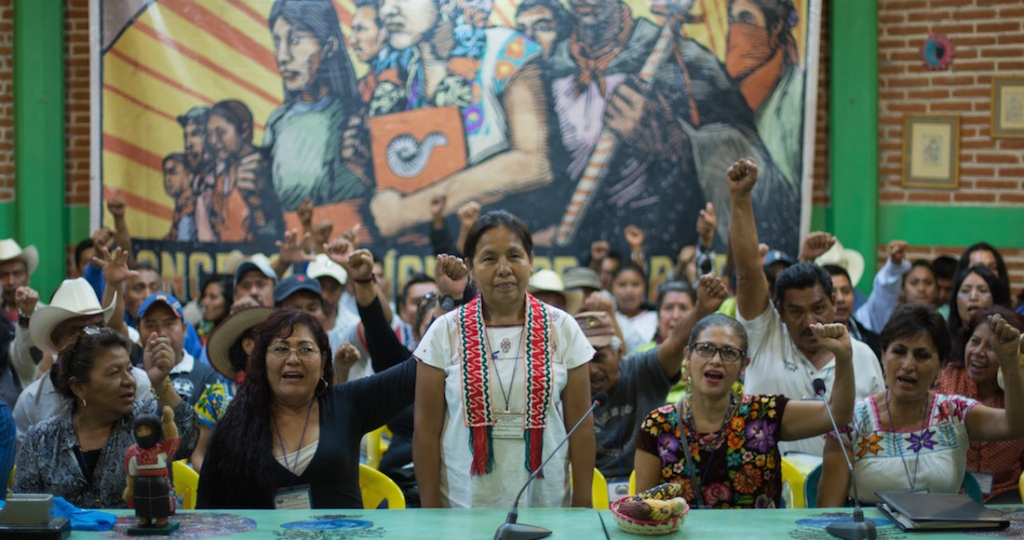
In the midst of the multiple hurricanes battering North America and the Caribbean, the fires burning in the US west, two major earthquakes in September, and a flurry of neglect and opportunism around emergency disaster aid and rescue, a rather different storm gathers in Mexico. The anti-capitalist Indigenous Governing Council and its spokeswoman, María de Jesús Patricio Martínez (Marichuy), a Nahuatl woman who will run as an independent candidate in the 2018 Mexican presidential elections, have just begun a national tour of Mexico, starting in the southernmost state of Chiapas in what has become a bastion of self-government and an inspiration for the world—Zapatista territory.
The Indigenous Governing Council (CIG) is an initiative of the National Indigenous Congress (CNI) and the Zapatista Army for National Liberation (EZLN), created through a referendum approved by 523 communities in 25 different Mexican states and proposing to collectively govern the country according to the CNI/EZLN’s seven principles of “Rule by Obeying.”* The CIG represents 42 indigenous peoples and 39 indigenous language groups—the majority of originary peoples in the country—and proposes to organize the (self)government, healthcare, education, and defense of indigenous and non-indigenous communities across Mexico. The CIG tour and its presidential campaign, as stated repeatedly by the CNI, does not aim to win votes but to harness the electoral limelight to denounce Mexico’s entire political class and the capitalist system which it holds responsible for the devastating violence, crumbling institutions, environmental destruction, and thriving organized crime that now dominate Mexico. According to CNI delegate Mario Luna of the Yaqui Tribe of Sonora, this campaign intends to enter the realm of elections—what has otherwise become “an internal negotiation among political parties”—with the explicit aim of promoting the expansion of assembly-based community self-organization across the country. The choice the CNI wants to provide the Mexican people, then, is not among candidates, but among entirely different forms of government.
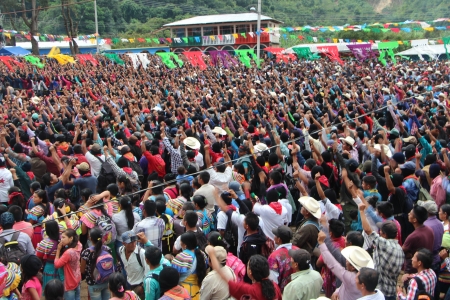
From October 14-19 of this year, a caravan of dozens of vehicles carrying Marichuy, 156 CIG council members, and several hundred more delegates of Mexico’s originary peoples wove through the mountains of Chiapas where they were met by tens of thousands of Zapatistas and non-Zapatistas across all five zones of Zapatista territory. The historic significance of the first indigenous woman presidential candidate was matched only by the stunning series of speeches given by indigenous women at every level of Zapatista authority: women representatives of the Good Government Councils, women regional authorities of the Zapatista Army, and women members of the Indigenous Revolutionary Clandestine Committee which commands the army—to name just the most prominent—a broad and powerful base of women’s leadership across both military and civilian entities in a place where just a few decades ago both indigenous women and men worked in slave-like conditions of permanent peonage for large landowners across the state.
An Electoral Turn?
The CNI, formed in 1996 as a result of the convergence of indigenous peoples all over the country around the demands of the 1994 Zapatista uprising, is the first nationally organized and representative indigenous body fully independent of state and party forces. The CNI’s deep community roots and autonomous organizing process stand in stark contrast to the tokenism and clientelism that characterized the past century of indigenous subjugation to the Mexican state. The CNI’s radical political independence make it an extremely inconvenient presence for the Mexican political class and thus a frequent object of total erasure and misrepresentation. This new initiative is no exception.
In fact when the Indigenous Governing Council has been mentioned, it has often been in the context of either condemnations or congratulations directed at the EZLN for having supposedly left behind a politics of autonomy and joined the electoral arena. Many within the Mexican government have long pushed the account that the EZLN had either fallen apart due to faulty leadership (inevitably attributed to then Subcomandante Insurgente Marcos, today SupGaleano) or faded into irrelevance due to isolation in their remote community strongholds. The CIG and the launch of its tour over the past weeks however has illuminated not a tired and outdated EZLN as some sources so desperately hoped for, but a wide range of flourishing community institutions and self-governing bodies that displayed, even at a glance, the breadth of Zapatista organization across multiple generations, multiple language groups, and multiple geographical contexts, articulated together as a large-scale, assembly-run, community-based social order with unparalleled organizational capacity.
More specifically, each stop in Zapatista territory revealed autonomous health clinics staffed with trained health promoters and medical equipment; autonomous school systems which had educated the young people now running their own media teams, governing bodies, and production cooperatives; tens of thousands of hectares of productive land worked collectively to provide sustenance for hundreds of thousands of people across Zapatista territory; independent transportation infrastructure; and thousands of Zapatista civilian army reserves that provided unarmed but formidably disciplined security rings around the CIG and its spokeswoman at every step. Noticeably, it was the Zapatista men who served visitors steaming plates of beef stew and homemade tortillas, organized lodging and distributed blankets, and washed dishes for the next busload of hungry travelers—this as Marichuy, the CIG councilwomen, and women authorities of the EZLN addressed the crowds from the stage.
Unsurprisingly, it seems that the political class doesn’t actually believe its own lies about the EZLN. They instead seem to be panicked that this form of collective self-emancipation will gain influence across Mexico. As evidence of this panic, and while the CIG initiative has been met with noticeably scarce media coverage, those who did try to cover the CIG’s tour of Chiapas ran up against the obstacle that as the caravan moved through the state, internet service, cellphone signals, and even landline service were cut across entire regions that would normally have robust communications, making timely media coverage nearly impossible. In addition to this communications blockade, the political class has done everything possible to inhibit the collection of the over 860,000 citizen signatures required by law for an independent candidate to appear on the ballot. The cellphone application made available by the National Electoral Institute (INE) for this purpose has proven not to function adequately except on high-end devices with new operating systems that cost well over the monthly earnings of the majority of the Mexican population. In a country lacking adequate internet service over large portions of the national territory, the application itself, as denounced by Marichuy on October 18, takes hours to download and once installed can take up to 16 hours to register a single signature (instead of the 4 minutes and 30 seconds claimed by the INE). There are many more examples, all of which point to an enormous amount of energy expended on subverting the reach of an organization and an anti-capitalist form of governing which the political class insists doesn’t exist.
Mexico’s Decomposition and the Urgent Need for an Alternative
In May of this year, the International Institute for Strategic Studies named Mexico the second deadliest country in the world, surpassing the violence in war zones like Yemen and Afghanistan and following only Syria in its death toll. Much of the violence in Mexico is attributed to the drug war launched in 2006 by then-President Felipe Calderón, but the numbers of dead (well over 200,000) and disappeared (30,000 by official estimates) and the utter impunity (around 98%) for these crimes display a more profound problem and the state’s complicity—when not direct involvement—in the violence. In addition, some 90% of productive land in Mexico has been ceded to foreign mining or logging companies and the paramilitary violence and state repression that tend to accompany such extractive industries to clear lands of resistant populations has resulted in millions more people subject to forced migration or internal displacement.
It is in this context that indigenous communities across the country have established autonomous self-governments and community self-defense units, expelling both drug cartels and political parties from their towns and cities, including (but not limited to) Cherán (Michoacán), Santa Maria Ostula (Michoacán), an extensive network of community police forces in the state of Guerrero, hundreds more CNI communities that are actively organizing to kick political parties out of their towns, and of course, as of almost a quarter century ago, the Zapatistas in Chiapas whose territory remains impenetrable to narco-control. In fact, practically the only places in the country not overrun by narco-related violence, trafficking, extortion, and joint rule by political party and cartel forces are these small sites of autonomous self-government where an intact or rebuilt social fabric and community self-defense mechanism has prevented such forces from taking hold. Such experiments in self-government constitute not an untouched outside to the otherwise grim reality of narco-state and capitalist mafia that stands in for government in Mexico, but an actual propositional alternative that relies on democratic processes and mass civil participation. It is in the context of a generalized social collapse that we can make sense of the CNI’s insistence that the Indigenous Governing Council is for all of Mexico, not just indigenous people, and they have invited non-indigenous people to join this initiative. In the words of Marichuy:
“That’s why we the indigenous peoples of the National Indigenous Congress and our brothers and sisters of the Zapatista Army for National Liberation have said that we won’t allow this anymore, that we are going to struggle and fight for everyone, not just for the indigenous peoples […] It is time for us to walk this path together with our brothers and sisters from the countryside and the city.”
Isn’t There Already a Left Presidential Candidate in Mexico?
As is standard across electoralist perspectives where the “least worst” establishment candidate is marketed as the only viable option to stop the reactionary right, that title in this case belongs to MORENA party founder and presidential candidate, Andres Manuel Lopez Obrador (AMLO). As three-time presidential candidate for the PRD (defrauded of a presidential win in 2006 and possibly 2012), AMLO has consistently promised to maintain “macroeconomic stability” and protect the interests of private capital while giving lip service to poverty reduction, a standard recipe for applying neoliberal policy behind a leftist veneer. One might ask, if “the left” has been characterized by its critique of capitalism, how is it that we have come to a point where a project for the attempted stabilization of capitalism can still be touted as on the left? In any case, the EZLN/CNI understand that given the crisis dynamics of contemporary capitalism, accepting a “lesser evil” logic means accepting the continued disintegration of Mexico and the disappearance of their peoples, and they thus recognize that Mexican society and the world have little choice today but to directly confront capitalism and all of its devastating consequences.
An Indigenous Governing Council for the World
As the failures of “progressive” electoralist forces pile up across the world—Syriza in Greece, Podemos in Spain, the PT in Brazil, renascent Peronism in Argentina, to name just a few—it becomes clear that we are not experiencing a battle between a reactionary right set on implementing xenophobic policies and protecting the class structure and a progressive left dedicated to inclusion and redistributive policies. Rather, where we are all going together is deeper into capitalist crisis and the disintegration of the system as a whole, with increasingly unstable global economic conditions, skyrocketing levels of inequality, scapegoating, and an alarming acceleration of environmental destruction. Under these conditions, the problem is not one of the political will of any individual politician or party; all kinds of cartels accompany systemic collapse and any political class under the imploding capitalist system merely becomes another. There are few places in the world where not only is the dissolution of the system clear, but an alternative already in formation with years (centuries!) of practice in collective decision-making and self-government. The insistence of the Indigenous Governing Council that the only alternative is not another political class but the elimination of the political class altogether is what makes this initiative not only the only viable organized possibility for the survival of indigenous communities in Mexico, but the path out of the disaster that is capitalism for all of us.
“But let’s not think, compañeras, that the Indigenous Governing Council or our spokeswoman are going to save us. We, each of us, has to work to save all of us, because if we don’t do anything our spokeswoman will not be able to save us either. She’s not the one who rules: it is the people who have to give the strength to our spokeswoman; it is the people who rule and our spokeswoman and our Governing Council have to obey the people.”
*The Seven Principles of Rule by Obeying:
To obey, not command
To represent, not supplant
To serve others, not serve oneself
To convince, not defeat
To go below, not above
To propose, not impose
To construct, not destroy
Carlos Gonzales: The National Indigenous Congress, a space of encounter and unity
Thirty years have passed since the creation of the National Council of Indigenous Peoples (Consejo Nacional de Pueblos Indígenas) in 1975. Of course, that organization and the supreme councils that constituted it were President Echeverría’s idea; their purpose was never to ensure the recognition of any indigenous rights. But once Echeverría’s term was over, the inevitable decomposition of that organization followed, as did the formation of critical strands from within it. These critical strands can be considered one of the origins of the new Mexican indigenous movement that over the past fifteen years has struggled for the long-denied constitutional recognition of indigenous peoples.
Around the edges of the aforementioned supreme councils, several very combative nuclei, especially with regard to the defense of indigenous territories, encountered and recognized each other. The National Coordinator of Indian Peoples (Coordinadora Nacional de Pueblos Indios) also came out of this process. Important leaders such as Pedro de Haro Sánchez, Aquiles Vargas, and Juan Chávez Alonso, the first two already deceased, experienced that period of rupture.
Some strands of thinking, joined together in the National Coordinator of the Ayala Plan (Coordinadora Nacional Plan de Ayala), were able to pioneer a way to distance themselves from the stiff discourse on the Left which diluted the properly indigenous struggle within the peasant struggle. In the 1980s, this growing indigenous movement was invigorated by peasant organizations made up primarily of indigenous people and movements that disputed the municipal power of local strong-man governments, as well as by the serious consideration being given to communality [comunalidad] in Oaxaca and the clearly autonomist revindications of the Independent Front of Indian Peoples [Frente Independiente de Pueblos Indios].
It was during the 1992 events around the fifth centennial of the so-called “discovery” of America that the indigenous movement reached a greater degree of unity and began constructing its own program of struggle that put autonomy at the center of its demands.
The indigenous uprising by the Zapatista Army of National Liberation (EZLN) in January of 1994 shook national society and made the oppression lived by the indigenous peoples of Chiapas and all of Mexico visible to the eyes of the world.
That uprising also allowed indigenous peoples to re-encounter each other and civil society as they never had before, seeking to build a shared resistance that would make possible the long-denied constitutional recognition of their collective rights.
The strength that the EZLN lent to the indigenous movement is multi-faceted. On one hand, the government was forced in February 1996 to sign the San Andrés Accords, committing to national reforms that would constitutionally recognize and grant autonomy to indigenous peoples. On the other hand, following two National Permanent Indigenous Forums in January and July of 1996, the indigenous movement succeeded in founding the National Indigenous Congress (Congreso National Indígena) (CNI) in October of that year.
Between 1994 and 1996, the indigenous movement confronted two positions: on one side was the position that defended regional autonomies as one more tier of government; on the other side was the formulation agreed upon in San Andrés regarding the articulation of municipal and community autonomies at whatever level and sphere they could be asserted and exercised. The former position was taken up by those who founded the National Indigenous Plural Assembly for Autonomy (ANIPA) in April of 1995; the latter joined the program of the National Indigenous Congress in October 1996.
The CNI, conceived from its origins as the “house of the indigenous peoples of Mexico,” represents the greatest achievement of the national indigenous movement in terms of building its own space. It is this space from which the EZLN and other indigenous organizations carried out multiple actions whose purpose was to demand the incorporation of the San Andrés Accords into the Federal Constitution and which culminated in the “March of the Color of the Earth” between March and April of 2001.
In the end the San Andrés Accords were betrayed by the political parties, which defrauded the movement with the indigenous counter-reform passed on April 28, 2001, as well as by the powers of the Mexican State which did not hesitate to approve and ratify said counter-reform.
Starting with that reform, which not only did not recognize the proposed rights but diminished others already in existence, the perspective taken up by the CNI and the indigenous movement was to refuse to recognize the counter-reform and to exercise via their actions the rights agreed upon at San Andrés.
That is what was agreed upon in the first meetings of the CNI in the Central Pacific Region (RCP) of the country and ratified in the Eighth National Assembly of the CNI. With the autonomous Zapatista experience as a reference point, an important current of thought has taken shape inside the indigenous movement over the last four years which puts forth for the first time the novel proposal of no longer seeking recognition of indigenous peoples in national legislation, but rather making that recognition and the associated rights real in fact and deed.
ANIPA followed a very different path, deciding to become a participant in official politics which tend towards the destruction of indigenous peoples, and their “struggle” for regional autonomy did not go beyond obtaining a few candidacies and government posts.
We should not be surprised, then, by the federal government-sponsored indigenous assembly held in Chilpancingo in September of 2002 which aimed to reduce the influence of Zapatismo in the national indigenous movement and “replace” the CNI, according to a pact made a few months prior in Tlaxcala. Nor should we be surprised by the early incorporation of several of its leaders into the neoliberal PAN government in 2001, nor by its combativeness against the EZLN and the autonomous municipality of Suljaa’.
More than four years after the “March of the Color of the Earth,” and beyond the divisions that exist in the indigenous movement and the incongruousness of a few leaders, today the CNI as a national space of unity is demobilized, with the exception of the Central Pacific Region which has held 16 sessions over four years of continuous work, always in rural communities embroiled in conflict in order to give visibility to their processes.
But from below, the indigenous movement exists, speaks, and reflects. In the sphere of what has been created in the CNI’s Central Pacific Region, the self-recognized communities there along with many other communities from Chihuahua, Veracruz, Oaxaca, Puebla, and Hidalgo not formally located in that region are organizing workshops, seminars, and meetings in order to understand and counter the multiple privatizations, laws, decrees, and programs with which the government and transnational corporations seek to invade and prey upon indigenous territories. In a loose network of communities, ejidos, organizations, and non-clientelist NGOs, they defend their food sovereignty and the peoples’ territories, their natural and spiritual resources, and the urgency of continuing to make viable their existence as peasants.
Now more than ever it is urgent to seek the unity of the indigenous movement which is organized independently of the State and to think through the viability of a national indigenous space that brings together all the forces which, in the face of the neoliberal disaster and its multiple policies of extermination, have decided that the struggle for the liberation of indigenous peoples is an anticapitalist struggle and one of unity with the other sectors of society, just as the Mixe thinker Floriberto Díaz already saw so long ago.
Carlos González is a legal advisor to several indigenous communities in the country and accompanies the Central Pacific Region of the CNI.
To To the People of Mexico, To the Peoples of the World, To the Media, To the National and International Sixth,
We send our urgent word to the world from the Constitutive Assembly for the Indigenous Governing Council, where we met as peoples, communities, nations, and tribes of the National Indigenous Congress: Apache, Amuzgo, Chatino, Chichimeca, Chinanteco, Chol, Chontal of Oaxaca, Chontal of Tabasco, Coca, Cuicateco, Mestizo, Hñähñü, Ñathö, Ñuhhü, Ikoots, Kumiai, Lakota, Mam, Matlazinca, Maya, Mayo, Mazahua, Mazateco, Me`phaa, Mixe, Mixe-Popoluca, Mixteco, Mochó, Nahua or Mexicano, Nayeri, Popoluca, Purépecha, Q´anjob´al, Rarámuri, Tének, Tepehua, Tlahuica, Tohono Odham, Tojolabal, Totonaco, Triqui, Tseltal, Tsotsil, Wixárika, Xi´iuy, Yaqui, Binniza, Zoque, Akimel O´otham, and Comkaac.
THE WAR THAT WE LIVE AND CONFRONT
We find ourselves in a very serious moment of violence, fear, mourning, and rage due to the intensification of the capitalist war against everyone, everywhere throughout the national territory. We see the murder of women for being women, of children for being children, of whole peoples for being peoples.
The political class has dedicated itself to turning the State into a corporation that sells off the land of the originary peoples, campesinos, and city dwellers, that sells people as if they were just another commodity to kill and bury like raw material for the drug cartels, that sells people to capitalist businesses that exploit them until they are sick or dead, or that sells them off in parts to the illegal organ market.
Then there is the pain of the families of the disappeared and their decision to find their loved ones despite the fact that the government is determined for them not to, because there they will also find the rot that rules this country.
This is the destiny that those above have built for us, bent on the destruction of the social fabric—what allows us to recognize ourselves as peoples, nations, tribes, barrios, neighborhoods, and families—in order to keep us isolated and alone in our desolation as they consolidate the appropriation of entire territories in the mountains, valleys, coasts, and cities.
This is the destruction that we have not only denounced but confronted for the past 20 years and which in a large part of the country is evolving into open war carried out by criminal corporations which act in shameless complicity with all branches of the bad government and with all of the political parties and institutions. Together they constitute the power of above and provoke revulsion in millions of Mexicans in the countryside and the city.
In the midst of this revulsion they continue to tell us to vote for them, to believe in the power from above, to let them continue to design and impose our destiny.
On that path we see only an expanding war, a horizon of death and destruction for our lands, our families, and our lives, and the absolute certainty that this will only get worse—much worse—for everyone.
OUR WAGER
We reiterate that only through resistance and rebellion have we found possible paths by which we can continue to live and through which we find not only a way to survive the war of money against humanity and against our Mother Earth, but also the path to our rebirth along with that of every seed we sow and every dream and every hope that now materializes across large regions in autonomous forms of security, communication, and self-government for the protection and defense of our territories. In this regard there is no other path than the one walked below. Above we have no path; that path is theirs and we are mere obstacles.
These sole alternative paths, born in the struggle of our peoples, are found in the indigenous geographies throughout all of our Mexico and which together make up the National Indigenous Congress. We have decided not to wait for the inevitable disaster brought by the capitalist hitmen that govern us, but to go on the offensive and convert our hope into an Indigenous Governing Council for Mexico which stakes its claim on life from below and to the anticapitalist left, which is secular, and which responds to the seven principles of Rule by Obeying as our moral pledge.
No demand of our peoples, no determination and exercise of autonomy, no hope made into reality has ever corresponded to the electoral ways and times that the powerful call “democracy”. Given that, we intend not only to wrest back from them our destiny which they have stolen and spoiled, but also to dismantle the rotten power that is killing our peoples and our mother earth. For that task, the only cracks we have found that have liberated consciences and territories, giving comfort and hope, are resistance and rebellion.
By agreement of this constitutive assembly of the Indigenous Governing Council [CIG when abbreviated in Spanish], we have decided to name as spokesperson our compañera María de Jesús Patricio Martínez of the Nahuatl people, whose name we will seek to place on the electoral ballot for the Mexican presidency in 2018 and who will be the carrier of the word of the peoples who make up the CIG, which in turn is highly representative of the indigenous geography of our country.
So then, we do not seek to administer power; we want to dismantle it from within the cracks from which we know we are able.
OUR CALL
We trust in the dignity and honesty of those who struggle: teachers, students, campesinos, workers, and day laborers, and we want to deepen the cracks that each of them has forged, dismantling power from above from the smallest level to the largest. We want to make so many cracks that they become our honest and anticapitalist government.
We call on the thousands of Mexicans who have stopped counting their dead and disappeared and who, with grief and suffering, have raised their fists and risked their own lives to charge forward without fear of the size of the enemy, and have seen that there are indeed paths but that they have been hidden by corruption, repression, disrespect, and exploitation.
We call on those who believe in themselves, who believe in the compañero at their side, who believe in their history and their future: we call on them to not be afraid to do something new, as this is the only path that gives us certainty in the steps we take.
Our call is to organize ourselves in every corner of the country, to gather the necessary elements for the Indigenous Governing Council and our spokeswoman to be registered as an independent candidate for the presidency of this country and, yes, to crash the party of those above which is based on our death and make it our own, based on dignity, organization, and the construction of a new country and a new world.
We convoke all sectors of society to be attentive to the steps decided and defined by the Indigenous Governing Council, through our spokeswoman, to not give in, to not sell out, and to neither stray nor tire from the task of carving the arrow that will carry the offensive of all of the indigenous and non-indigenous peoples, organized or not, straight toward the true enemy.
From CIDECI-UNITIERRA, San Cristóbal de las Casas, Chiapas
May 28, 2017
For the Full Reconstitution of Our Peoples
Never Again a Mexico Without Us
National Indigenous Congress
Zapatista Army for National Liberation
Alvaro Reyes: Zapatismo: Other Geographies Circa the “End of the World”
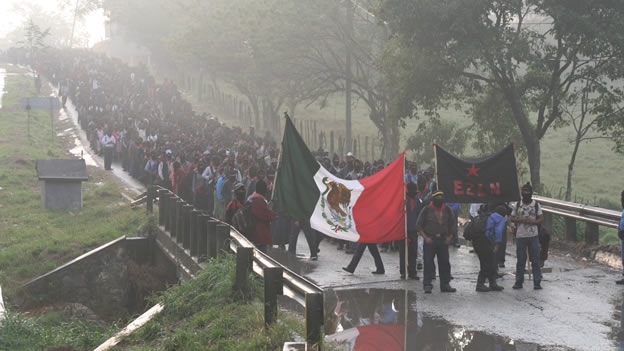
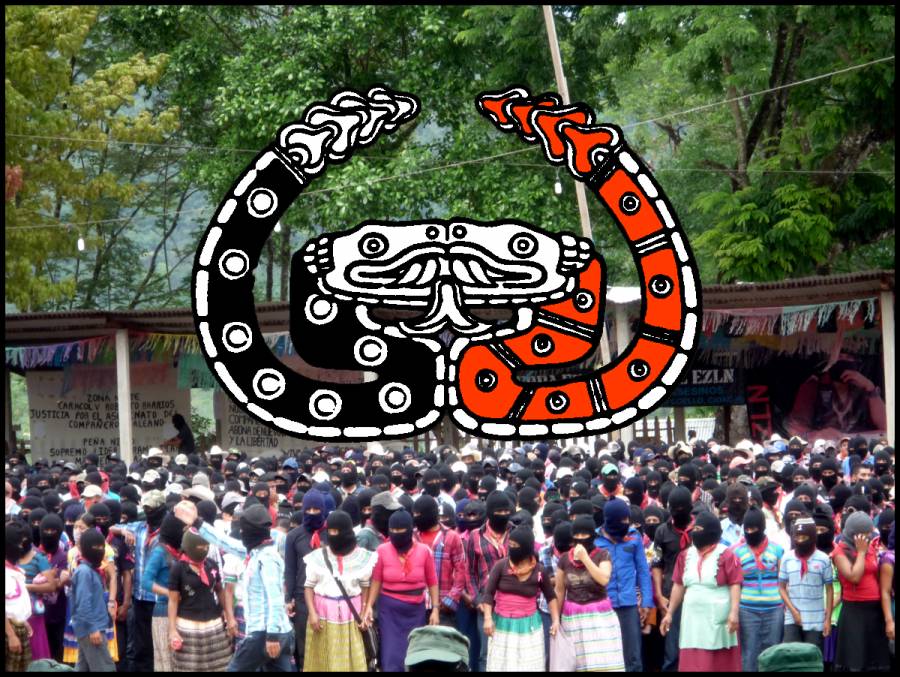
As daylight broke across the Southeastern Mexican state of Chiapas on 21 December 2012, news cameras fixated on the throngs of tourists that had overtaken the state to witness the ‘end of the world’ purportedly predicted by the ancient Maya. Yet in the cities of Altamirano, Palenque, Las Margaritas, Ocosingo, and San Cristóbal de las Casas reports began to emerge of unusual activity: groups of indigenous people constructing makeshift wood stages atop the back of pickup trucks. Hours later 45 000 masked members of the Zapatista Army of National Liberation (EZLN), all of them Chol, Tzeltal, Mam, Tojolobal, Zoque, and Tzotzil Mayan indigenous peoples, descended on these city centers in perfectly ordered columns. Bystanders stood incredulously in front of the improvised stages waiting for the masked Mayans to make a statement of some sort, but the Zapatistas marched by the thousands across the stages in chilling silence with their left fists in the air. In a matter of hours, the Zapatista contingent had left the city centers in the same silence and with the same much-commented-upon discipline with which they had arrived, leaving many wondering what this—the largest march in the history of Chiapas and the largest mobilization of Zapatistas ever seen—was all about. Late that evening, an equally cryptic five-line message appeared on the EZLN’s website. Signed by Subcomandante Insurgente Marcos for the General Command of the EZLN, it read:
“ To Whom It May Concern: Did you hear that?
That is the sound of your world crumbling.
That is the sound of our world resurging.
The day that was day was night.
And night shall be the day that will be day” (EZLN, 2012a, my translation).
In a communiqué a few days later, the Zapatistas would further aid us in unraveling the mystery surrounding their actions of 21 December 2012, stating that what others had mistaken for prophecy (that is, ‘the end of the world’), they had set out to make promise (that is, ending this world) (EZLN, 2012b).
Amazingly, just months before their massive ‘End of the World’march, the EZLN had been declared all but dead by a number of sectors of Mexican society. In this paper I will attempt to fill a lacuna in Anglophone academic discourse by offering a comprehensive analysis of the events surrounding both the ‘death’ and ‘resurgence’ of the EZLN. The paper is divided into two major sections. The first, titled “The death of the EZLN? Or the death of Mexico?” begins with an examination of the way in which, after an explicitly ‘anticapitalist’ reorientation of its political strategy in the early to mid-2000s, the EZLN became radically isolated from the ‘progressive’ and institutional left in Mexican society and was effectively declared dead by the Mexican government. In order to understand the epochal societal shifts that made the EZLN’s strategic reorientation necessary, I examine the contemporary decomposition of Mexico that began with the evisceration of communal land tenure and Article 27 of the Mexican constitution, opening it to the destructive dynamics of neoliberal reterritorialization. Having laid out the end of the social contract that had made ‘the people of Mexico’ a reality, I end this first section by outlining the contemporary growth of legal exceptionality in Mexico and of political rule through the terror that now engulfs the country with the full complicity of the entire Mexican political class. In the second major section of this paper, “Life after death: how the EZLN proposes to build postcapitalism”, I develop three major points through a close reading of Zapatista texts and a firsthand account of contemporary Zapatista political institutions. First, I show that the EZLN, through a systematic analysis of the structural crisis of capitalism, both foresaw and explained the situation that now grips Mexico and increasingly, according to the Zapatistas, the rest of the world. Second, I analyze the way that the EZLN, by adding new dimensions to the ‘geometry’ of political struggle, is able to conceptualize a ‘world’ in the here and now beyond that of neoliberal capitalism, potentially freeing political thought and action far beyond Chiapas from the mutually reinforcing dead ends of either reviving neoliberal capitalism or falling into apocalyptic despair. Finally, through a brief personal narrative of my own experience in 2013 as a student of what the Zapatistas termed their ‘Little School’, I examine the ways in which the Zapatistas’ political strategy, based on the construction of alternative institutionality, has been intimately tied to the practices of building what they call ‘another geography’. This construction of new nonseparatist territorial practices has today been taken up by other organizations across Mexico and increasingly overlaps and contradicts the territories of neoliberal calculation and destruction. I argue that these Zapatista ‘other geographies’ might serve as concrete examples of a viable anticapitalist spatial strategy and therefore must be taken far more seriously than they have been by the left generally and critical geography more specifically.
Section I: the death of the EZLN? Or the death of Mexico?
A Chronicle of a death foretold
The EZLN is today still most widely known for its 1 January 1994 uprising against the Mexican government. Those twelve days of armed action turned out to be one of the first volleys in what would become a generalized region-wide wave of resistance against the ever-deepening consolidation of an incredibly unstable and brutal neoliberal project in Latin America (Reyes, 2012). The EZLN’s uprising soon gave way to negotiations with the Mexican government and the then ruling Institutional Revolutionary Party (PRI)—negotiations that from the very beginning centered on the EZLN’s demand for the reintroduction of the de jure protection of collective land tenure that had been eviscerated as a condition of Mexico’s entry into the North American Free Trade Agreement (NAFTA). Through these negotiations the EZLN’s struggle became a central rallying point for a wide panoply of opponents of neoliberal ‘reform’ in Mexico, from radical unions to debtors’ organizations, from indigenous and peasant organizations to the progressive elements of Mexico’s ‘left of center’ Democratic Revolutionary Party (PRD).
In order to achieve this, the Zapatistas chose to develop (at least publicly) a discursive strategy centered on the voice andimage of Subcomandante Insurgente Marcos. In formulations that suggestively parallel Ernesto Laclau’s (1996) analysis regarding the political centrality of the “empty signifier”, the Zapatistas describe their discursive strategy as an attempt to construct the figure of ‘Marcos’ as a placeholder for the desires of the widest swath of Mexican society possible. As the EZLN notes, at that time there was a ‘Marcos’ for every occasion and every political persuasion (EZLN, 2014a). Mexican society took up this figure as their own, as could be evidenced by the highly popular refrain of “Todos somos Marcos”. This was a phrase that had the virtue of illustrating precisely the political potential of the empty signifier, in that in Spanish it simultaneously denotes this figure’s power to unite (“We are all Marcos”) and premises that space of unity on radical social dispersal (“Marcos is all of us”). The Zapatistas hoped, then, that through this empty signifier an extremely fragmented Mexican ‘civil society’ might unite against the common neoliberal enemy embodied by the PRI. The figure of ‘Marcos’ was thus the placeholder for the ‘counter-hegemony of the diverse’ (page 402) that would seek not so much to impose ‘a revolution’ as to coordinate the forces inside and outside of the state in order to build a space of egalitarian articulation (Rabasa, 1997). This would be a ‘radical democracy’ (page 418) where the direction and purpose of that future revolution might be disputed by Mexican ‘civil society’ (Rabasa, 1997). Importantly, through this discursive strategy, the EZLN’s influence at the time was such that, as the Mexican analyst Luis Hernández Navarro (2013) reminds us, its uprising and subsequent opposition was the single largest (but not the only) reason for the eventual fall of the PRI’s seventy-year dictatorship.
Salinas de Gortari and his PRI successors, for their part, eschewed serious negotiation with the EZLN and sought instead to isolate the EZLN through a counterinsurgency plan detailed in the Mexican Secretary of Defense’s Plan de Campaña Chiapas 94 that included the formation of paramilitary organizations in Zapatista-influenced regions, as well as the targeted use of government subsidies to divide Zapatista communities.(1)
In 2001, with the PRI out of presidential office for the first time in seventy years, the Zapatistas took their initiative for Constitutional Reforms on Indigenous Rights and Culture across Mexico in what they termed ‘The march of the color of the earth’. Millions of Mexicans, with representatives from fifty-six of Mexico’s indigenous peoples and more than a few internationals, came out in an overwhelming show of support for this new initiative. The march culminated on 11 March 2001, with over a million Zapatista supporters filling Mexico City’s enormous Zócalo. The magnitude of support for the event generated widespread expectation that at least some versions of the Zapatistas’ proposed reforms would be approved by the Mexican legislature and signed by then President Vicente Fox. Despite widespread support for their initiative, the Zapatistas’ efforts at constitutional reform met with utter failure as all three major political parties in the Mexican senate—the right-wing National Action Party (PAN), the center-right PRI, and, most surprisingly, the institutional ‘left’ represented by the PRD—joined together to oppose the EZLN’s constitutional reforms. Thus, after years of (at least outwardly) crafting a national counterhegemonic project, what had been the Zapatistas’ discursive strategy up until that point reached an obvious dead end. Many analysts believed at the time that the EZLN would simply return to Chiapas and limit its activities to its communities of influence while leaving questions of national political power to others. More specifically, much of the ‘progressive’ left in Mexico imagined that the EZLN would support the growing strength of the electoral left embodied in the PRD—a party that many in Mexico imagined would come to power in direct parallel to the rise of counterhegemonic ‘progressive governments’ throughout the rest of Latin America. Much to their dismay, the EZLN instead released the Sixth Declaration of the Lacandón Jungle on 25 June 2005, explicitly severing all ties to the entire Mexican political class. Most surprisingly, it definitively and harshly distanced itself from the presidential campaign of the PRD’s Andrés Manuel López Obrador (AMLO), noting that it could not and would not partake in the ‘change’ that the electoral left imagined he embodied. The EZLN reasoned that the PRD had explicitly worked to defeat the Zapatistas’ initiative on constitutional reforms, that PRD officials (the great majority of them ex-PRI operatives) had partaken in counterinsurgent actions against the Zapatistas, and most importantly, that the PRD and AMLO had explicitly made their peace with the international neoliberal order (EZLN, 2005a). AMLO had praised the PAN’s Vicente Fox for having achieved what he termed ‘macroeconomic equilibrium’ (specifically referring to the neoliberal axioms of reduced deficit spending and low inflation) for Mexico. AMLO vowed to maintain that ‘equilibrium’ and asserted that “State action does not suffocate the [private] initiative of civil society” (Petrich, 2011). Thanks to documents obtained by Wikileaks, we know such statements had their desired effect, if only with the US embassy in Mexico. In an aptly titled cable, “AMLO: Apocalypse Not”, US ambassador Tony Garza concluded that AMLO was “putting the correct pieces into place” and that among its proposed cabinet members, “none of them are radicals.” In fact, subsequent US embassy cables go on to speculate that much of AMLO’s ‘populism’ was simply ‘campaign rhetoric’, and that when faced with proposals emanating from within left sectors of Mexico’s political class, the embassy reassured Washington, “We don’t think AMLO will support these more radical ideas” (Petrich, 2011, page 2).
Yet the Zapatistas did not read the PRD’s political betrayal as an attack solely on them, nor as the result of the personal failings of AMLO. As would later become evident, they saw their predicament as a clear sign of the arrival of a new objective political situation in Mexico as a whole. On the basis of what they had learned over previous years, they stated, “we rose up against a national power only to realize that that power no longer exists … what exists is a global power that produces uneven dominations in different locations, what we are up against is finance capital and speculation” (Zapatista 1999). This realization, then, required a new strategic outlook for Zapatismo, one whose tone was captured by Subcomandante Marcos when he stated, “we no longer make the distinctions we once made [among the Mexican political class], between those who are bad and those who are better. No, they are all the same” (Castellanos, 2008, page 54).
As a direct contestation to the political class, the Zapatistas set out in 2006 on what they called ‘the other campaign’. This was neither an initiative for any of the existing presidential candidates nor a call for abstention. Rather, it was a campaign to highlight the need to build an explicitly anticapitalist organization across Mexico that would in effect create what they called ‘another politics’ and thus act as a counterforce to the alliance of the political class and capitalism. The Zapatistas predicted that many of their former supporters would quickly turn on them and staunchly defend the presidential candidacy of AMLO and electoralism more generally. In fact, they were so certain of this outcome that they wrote a preemptive ‘(non)farewell’ letter addressed to ‘civil society’ attempting to explain their position and, in a sense, publicly foretelling their impending death (EZLN, 2005b). Their intuition proved correct: Mexico’s institutional left was flabbergasted, and reactions to the EZLN’s new initiatives were swift and often vicious. The isolation of the EZLN from the institutional left would only become more severe when, after what was almost certainly electoral fraud during the 2006 presidential election (Díaz-Polanco, 2012)—the mechanics of which were detailed and roundly denounced by Subcomandante Marcos live on radio the day after the election(2)—some on the electoral left went so far as to tie the EZLN’s critique to AMLO defeat (Rodriguez Araujo, 2006). Subsequently, coverage of the EZLN and EZLN communiqués all but disappeared from Mexico’s ‘progressive’ press. From that point on, it was not uncommon to encounter among the institutional left and its progressive allies (especially in Mexico City), the idea that “the EZLN no longer exist[ed].”(3)
Upon assuming the presidency in December of 2006, Felipe Calderón of the right-wing PAN quickly seized upon the EZLN’s political isolation. Calderón designated a long-time PAN operative, the nonindigenous Luis H Álvarez, as Director of the Office of Indigenous Development. Álvarez by his own account spent much of his initial years in this post trying to mount what he termed a ‘peaceful’ counterinsurgency strategy in Chiapas. Álvarez’s strategy in effect served as an intensification of the counterinsurgency strategy Plan Chiapas 94. By directing federal subsidies toward Zapatista communities that would agree to leave the organization (and thereby abandon its policy of not accepting government money), Álvarez hoped to pull the EZLN base away from its leadership, a strategy that by 2012 Álvarez claimed had been a resounding success.
With the release of Álvarez’s book Indigenous Heart: Struggle and Hope of the Original Peoples of Mexico in June 2012, the narrative of the supposed demise of the EZLN that circulated within the political class reached its peak (only a few months before the Zapatistas’ thunderous reappearance on 21 December 2012). The book release became a celebration and a funeral of sorts, organized in order to show the Mexican nation the body of the defunct EZLN via live stream. Both Calderón and an ecstatic Álvarez openly reveled in the disappearance of the EZLN and personally took credit for resolving what they called the ‘indigenous problem’ in Chiapas. If the EZLN had, as Álvarez and Calderón claimed, in effect been killed off, the body of EZLN spokesperson and military strategist Subcomandante Insurgente Marcos stood in for the EZLN as a whole. According to Álvarez, reading aloud from his book, as Marcos languished in the throes of terminal lung cancer, he had, unbeknownst to the rest of the EZLN, approached the Mexican government for medical help that would save him. According to another story, circulated by the Al Jazeera News Network, Subcomandante Marcos was about to suffer what must certainly be the only fate worse than death for a Latin American guerrilla leader: he had accepted an offer to leave the EZLN and live out his life as a professor in a small town in upstate New York (Arsenault, 2011).(4)
In sum, for Mexico’s traditional political class, its ‘progressive’ left, and many of their would-be international supporters, as of mid-2012 the Zapatistas and their spokesperson Subcomandante Marcos were as good as dead.
B. Neoliberal reterritorialization: the death of Mexico?
From the late 1980s to 2000 the PRI, still operating as a de facto state party, attempted to implement a series of structural reforms to privatize electricity, education, collectively held lands, and the national oil industry and thus erode the mechanisms of redistribution that had been established by the postrevolutionary constitution of 1917. This initial set of reforms was touted by the PRI, and more specifically by Carlos Salinas de Gortari, as the dawn of a bright new neoliberal era for Mexico.
Throughout the 1980s and 1990s, under the advisement of the World Bank and in preparation for the upcoming NAFTA, the burgeoning neoliberal establishment in Mexico viewed the collective forms of land tenure as the key impediment to foreign direct investment and ‘economic growth’.(5) These forms of inalienable, imprescriptible, and nontransferrable land tenure—ejidos and bienes comunales—had been protected by Article 27 of the Mexican Constitution. Article 27 had also granted agrarian communities rights over common-use lands and their resources, making all natural resources found in the subsoil property of the nation. Through changes to Article 27 that opened communal land to rent, sale, and use as collateral to obtain commercial credit, and through state programs such as PROCEDE(6) providing economic subsidies in exchange for the individual ‘certification’ of collective lands (the first step in a process that it was hoped would end in private titles), the PRI took direct aim at what they viewed as the least ‘income-yielding’ sector of the Mexican economy.
If we take up the legal theorist Carl Schmitt’s (2003) lesson that all political ideas imply a particular spatial order and vice versa, there is no single piece of legislation in postrevolutionary Mexico that embodies this precept as obviously as Article 27 of the Mexican constitution. The territorial reordering implied in attacks on ejidal and communal land that were frequently discussed in terms of simple ‘economic’ expediency were in fact nothing short of a direct attack on the postrevolutionary political status quo that had tenuously reigned in Mexico since 1917.
Postrevolutionary Mexico’s capitalist fractions had hoped to contain the threat of radical forces such as those of Emiliano Zapata’s Ejército Libertador del Sur by creating a territorial order that would provide the material and symbolic suture between capitalist economic growth, the institutions of state mediation, and the majority of the Mexican people understood as peasant laborers. They did this by placing the ejido (and the productive labor therein) at the very center of the postrevolutionary juridical order. In effect, I think we must understand Article 27 as the space and juridical ground upon which the constitutional entity of ‘the Mexican people’ found its material existence beyond that of an abstract existential entity, beyond that of an ‘identity’. Article 27 contained the specific spatial ordering in which ‘the people’ (be they capitalists or Zapatistas) could (co)exist in a clearly hierarchical but (potentially) redistributionist truce.
In this way, Mexico prefigured in an agricultural context what Antonio Negri calls the ‘constitutions of labor’ formed in the factory-centered societies of Europe and the United States after the Second World War. In these societies, labor (in the case of Mexico, agrarian labor) is recognized as both the basis of social valorization and “the source of institutional and constitutional structures” (Negri, 1994).(7) Importantly, then, when all three major political parties struck down the EZLN’s initiative to revive Article 27 through the Constitutional Reforms on Indigenous Rights and Culture, this was not due solely to the fact that the Mexican political class desired to exclude the indigenous peoples of Mexico from ‘the Mexican people’. It was also due to the far more novel situation in which the Mexican political class, through its complete abandonment of the territorial ordering implied in Article 27, was now willing to openly acknowledge that the breakdown of the postrevolutionary mediational state was in fact irreversible. The actions of the political class were alerting all of Mexico (although few outside of the EZLN seemed to notice) to the fact that the death of ‘the Mexican people’ had already taken place, and that no one can be included or excluded from something that no longer exists.
C. Terror as strategy
By the mid-2000s, and despite enormous efforts such as PROCEDE and cuts to agricultural subsidies, it became clear that the great majority of collective landholders in Mexico refused to give up their collective titles, preferring even to rent out their land in order to generate income rather than modify its collective character (de Ita, 2006). This led actors within the World Bank, the ever-interventionist community of US military analysts, and the Mexican political class to assert that before further neoliberal reforms could succeed, the longstanding efforts to dismantle collective land tenure would have to be redoubled (Bessi and Navarro, 2014; World Bank, 2001).
At the very moment when the Mexican state was reinforcing its efforts to cut back social programs for, and mediational presence in, agricultural communities, an increasingly unprotected workforce was coming into contact with the transnational drug economy. That burgeoning economy not only sought to use Mexico as a transportation corridor for South American cocaine headed for the US, but also looked to amass the land, workforce, and transportation infrastructure necessary to make Mexico the fastest growing producer and supplier of heroin and methamphetamines for US consumption (Watt and Zepeda, 2012, pages 76–83). Thus, the reterritorialization implicit in the changes to Article 27 abutted and abetted the territorial reorganization required by the increasing competition for land, transportation routes, and profits within the illicit drug trade.
Although competition for the high-yielding speculative profits of this illicit trade are bound to involve heightened levels of violence, many today believe that Calderón’s policy response to the growth of the drug trade—the rollout of a full-blown ‘war on drugs’—did not arise from the existence or nature of the drug trade itself. As the academic and military affairs analyst Carlos Fazio hypothesizes, Calderón, in conjunction with the US State Department, circulated the notion that the illicit drug trade amounted to a ‘narco-insurgency’, a rogue ‘parallel state’ in the making. This narrative, Fazio believes, served to propagate the idea that the widespread militarization of Mexican society was absolutely necessary in order to neutralize the threat from what Calderón called a burgeoning ‘internal enemy’ (Fazio, 2013). The danger posed by this ‘internal enemy’ in turn justified the nullification of constitutional measures that prohibited the Mexican military from fulfilling domestic police functions, as well as the implicit cancellation of civil liberties and due process this would imply on a daily basis in the country’s streets. For Fazio (2013, pages 371–406) then, this ‘war’ would necessarily amount to nothing less than the de facto imposition of a ‘state of exception’ in in which as Giorgio Agamben (2005) explains, the application of the norm is suspended, “while the law remains in force” (page 31).
Notably, after Calderón’s declaration of a war on drugs and the consolidation of a state of exception, the drug trade in Mexico actually flourished. Consider, for example, the fact that between 2006 and 2012 the production of heroin and marijuana grew and the production of methamphetamines absolutely exploded, while at the same time fewer poppy fields and marijuana plants were destroyed and seizures of cocaine went down. Consequently, six years after Calderón’s war on drugs began, Mexico had become the single largest point of production and transportation for the illicit drug trade in the Americas (Hernández, 2013a).
If the growing state of exception seemed to leave the drug trade untouched, it did result in what Le Monde called “the most deadly conflict on the planet in the last few years”: between 80 000 and 150 000 dead, approximately 30 000 more disappeared, and some 1.5 million people forcibly displaced (Hernández, 2013a, pages 9–13). As Melissa Wright has pointed out, rather than provoking outrage, these grim statistics seemed to have become the very foundation of the Mexican state’s new efforts at legitimation. That is, given its inability to provide the redistributive benefits of past decades, the new Mexican state began to redefine social progress by shifting from a discourse of national development to that of national ‘security’. Within this new discourse of security, the Mexican state now functions under the assumption that all those killed in drug-related violence should be presumed elements of the ‘narco-insurgency’. Therefore, the worse these drug-related statistics become, the greater the proof that the Mexican state has fulfilled its duty to protect the population from this growing internal threat (Wright, 2011, pages 285–298).
Given this apparent shift from the discourse of development to that of security, Fazio and the Mexican sociologist Raquel Gutierrez (among others) believe it is a mistake to simply discount the Mexican state’s war on drugs as a failure. These analysts believe that in addition to providing the basis for a new form of state legitimation, this ‘war’ is best understood as a direct response to the antineoliberal resistance that immediately preceded the war on drugs. It is important to remember that the package of neoliberal reforms from the late 1980s onwards was met with an uncoordinated yet unprecedented wave of resistance across Mexico (Gilly et al, 2006). Although this is rarely acknowledged, this wave of antineoliberal resistance or ‘generalized social insubordination’ to neoliberalism proved to be the determining political factor in Mexico for years to come, just as in the rest of Latin America (Gutierrez Aguilar, 2005; Reyes, 2012). In fact, these scholars argue that the actions of the Mexican political class in the last two decades can be understood only when viewed as a counteroffensive to this resistance. More specifically, these analysts claim that the purpose of this war on drugs was to neutralize these struggles in three very specific ways. First, the inordinate amount of violence this ‘war’ unleashed allowed the Mexican political class to conjoin politics and terror—to practice politics as terror—which in turn created a sense of fear and social isolation among Mexico’s residents and undermined the web of alternative socialities that had subtended antineoliberal resistance (Fazio, 2013, pages 377–380). Second, the social fragmentation produced by the generalization of fear in the war on drugs had the ‘benefit’ of breaking down Mexican society’s capacity to come to a general understanding of what was actually taking place (of what was what, and who was who). As Gutierrez explains, this in turn opened the possibility that instead of the political ‘cooptation’ that had characterized the counterinsurgency practices of the PRI dictatorship, today’s counterinsurgency (sans redistributionary mechanisms) might instead consist of sowing ‘confusion’ so that the very reasons for struggle are irretrievably lost, even to social movements themselves (Brighenti, 2013). Finally, on the ground across Mexico, the war on drugs allowed for coordinated action of state and paramilitary forces—under the orders of the political class, drug cartels, and transnational corporations—against community-level resistance (Lopez y Rivas, 2014). As a perfect illustration of Gutierrez’s point regarding the political deployment of confusion, these forces are often presented to the public by state officials and the media as grassroots community movements that have arisen against the power of drug cartels.
Given the effects of these strategies, the political class now felt prepared to square the macabre circle of neoliberal policy in Mexico. In December 2012, after twelve years of absence, the PRI, through Enrique Peña Nieto, returned to the presidency. In what has been referred to as a ‘lightning’ strategy, and counting on the weakening of antineoliberal resistance, Peña Nieto once again presented the longstanding proposals for the privatization of oil, education, and health care, the further evisceration of protection of collective land tenure, the elimination of the progressive elements of the federal tax code, and the deregulation of labor law. Amidst the giddiness of a reactivated neoliberal offensive (as well as an unmentioned 25 000 drug- war-related deaths during his first year in office), TIME magazine concluded Peña Nieto and this package of reforms were poised to ‘save Mexico’ (Crowley and Mascareñas, 2014). This time around, and unlike in the mid-1990s, the Mexican political class as a whole stood shoulder to shoulder with the core of PRI policy. In fact, within weeks of the PRI’s return to the presidency, all three major political parties (PAN, PRI, and PRD) signed the ‘national pact for Mexico’. The ‘national pact’ was an outline agreement of how these parties would cooperate in the Mexican legislature and senate to finally achieve the neoliberal reforms that had been slowed by the resistance of the past decades. For many, the PRD’s participation in Peña Nieto’s neoliberal ‘pact’ made it painfully clear where the left’s electoralist strategy in Mexico had led: in the words of PRD founder Porfirio Muñoz Ledo, the PRD and the electoral left in Mexico as a whole had over the last two decades “accomplished everything [they had] set out to oppose” (Villamil, 2013, page 32).
Importantly then, the Mexico that the EZLN marched ‘back’ into on 21 December 2012 was not the same country. Rather, the tendencies toward national decomposition pointed out long ago by the EZLN had clearly taken a devastating toll on Mexican society. As became clear to the rest of the world through the much-publicized case of Ayotzinapa, Guerrero (Gibler, 2015), the consequences of this social disintegration have been grave: the death of ‘the Mexican people’, the generalization of terror, the weakening of antineoliberal resistance, a fully complicit institutional left, and tens of thousands of dead and disappeared. Given this context, it is no exaggeration to suggest that, in its rush to bury the Zapatistas, the ‘progressive’ left neglected to ask itself if throughout those same years it was not Mexico itself that was slowly dying.
Section II: life after death: how the EZLN proposes to build postcapitalism
A. The world that is crumbling
Despite the disastrous role of the electoral left in both legislating and legitimating neoliberalism in Mexico, as bitingly summarized by Muñoz Ledo above, there exist few systemic accounts (that is, accounts that move beyond personalist narratives of ‘greed’ and ‘betrayal’) that offer us a comprehensive explanatory framework for the contemporary decomposition of Mexico and the changing structural role of the state and political class within that decomposition. Lacking this systemic account, a number of theorists have turned their attention to the Zapatistas’ break with the Mexican political class and their attempts at building ‘another politics’, and concluded that these amount to nothing more than a sectarian ‘antipolitical’ drift that has led to the ‘failure’ of Zapatista initiatives and to their increasing political irrelevance (Almeyra, 2014; Mondonesi, 2014; Wilson, 2014). It should be noted here that these supposed EZLN shortcomings are often explained in terms of the personal failings (that is, the intransigence, sectarianism, and envy) of its (former) spokesperson Subcomandante Marcos (Almeyra, 2014; Rodriguez Araujo, 2008).
Yet, in sharp contrast to these analyses, after the failure of their initiative on constitutional reforms, the Zapatistas set out on an extensive evaluation of contemporary capitalism that in many ways foresaw the destructive dynamics that today grip Mexico and, increasingly, the rest of the world. In order to examine the Zapatistas’ account of these dynamics, we might first ask what it is that they meant in their 21 December 2012 message that ‘your world’ is ‘crumbling’. Examination of the Zapatistas’ extensive literature on this topic makes evident that for them, the world that is crumbling is that of capitalism. In their description of the crumbling of this world, the Zapatistas ask us to imagine capitalism as a building of sorts. In the past, those on top of this world would add floors to the building—what Marx would have referred to as the expanding ‘self-valorization of value’ (Marx, 1976), or what is often erroneously referred to as ‘growth’. This is a process made possible through the exploitation, dispossession, repression, and disvalorization of those below—what the EZLN refers to as ‘the four wheels of capitalism’ (EZLN, 2013). This allowed those on top to further distinguish themselves, while creating the possibility (however remote) that those below (at least those willing to give in to the social relations of the value form) might move up a floor (most often through redistributive state action).
Today, as the Zapatistas explain, within neoliberal globalization the four wheels of capitalism continue on with a vengeance, but have come unhinged from the capitalist motor that previously drove the construction of new floors (EZLN, 2013). Absent the capacity to build new floors (to rise on the back of the expansion of the self-valorization of value), those on the top of the capitalist world building have little choice but to systematically turn to ‘speculation’ (that is, the attempt to stay on top through profitability minus value expansion) (EZLN, 2014a). According to the Zapatistas, these ‘speculative’ attempts of those at the top to maintain their elevated positions can only come at the cost of the short-sighted and disastrous demolition of the floors and building foundations below them (EZLN, 2013). Consequently, the social relations, territories, and institutions dependent on the expansive dynamic of the self- valorization of value—perhaps most importantly, the state—are completely refunctionalized. From this perspective, political spaces (that is, those spaces between state and civil society), which previously served as sites for mediation, deliberation, and representation, today are reduced to guaranteeing immediate corporate profitability. Lacking the material with which to mediate social conflict (that is, growing self-valorizing value) that in previous eras might have allowed for redistribution and some dialectic of demand and reform, the state now becomes the central machine for demolition, for unilateral dispossession and repression (the cause of the dynamics of ‘exceptionality’ highlighted by Fazio above). Thus, the Zapatistas claim that the era in which capital and the state could uphold even a semblance of peace and stability is over (EZLN, 2014a).
Given this refunctionalization of the state, the problem for Mexico under the “reign of speculation” (that is, neoliberal globalization), according to the Zapatistas, is not “that the political system has links to organized crime, to narcotrafficking, to attacks, aggressions, rapes, beatings, imprisonments, disappearances, and murders”, but rather “that all of this today constitutes its essence” (EZLN, 2014b, no page number). The Italian journalist Roberto Saviano offers a strikingly parallel insight in his 2013 foreword to Anabel Hernández’s Narcoland. Saviano notes that too often the cataclysmic violence that Mexico faces has been minimized and misunderstood by attributing it to a “mafia that has transformed itself into a [transnational] capitalist enterprise”, effectively coopting the Mexican state. For Saviano, however (as well as for the Zapatistas), this perspective entirely misses the point that in the era of speculation “[transnational] capitalism has transformed itself into a mafia”, effectively creating a world in which political economy and criminal economy are but one and the same (Hernández, 2013b, pages viii–x). According to the Zapatistas, then, the problem is not that states have disappeared but rather that they have been entirely remade as nodes of a single global network of contemporary ‘mafia capitalism’ [what the EZLN calls ‘the empire of money’).
I think we must understand three important points that follow from this Zapatista analysis. First, in sharp contrast to the analysis suggested in 2009 by the (now defunct) US Joint Forces Command (Debusmann, 2009), the Zapatistas in no way believe that Mexico is—or is on the verge of becoming—a ‘failed state’. For them Mexico is, rather, a paradigmatic example of a ‘successful’ contemporary capitalist ‘(non)national state’, with all the death, fragmentation, and destruction this entails (EZLN, 2005a). Second, the political class and the institutional left cannot simply stand above the refunctionalization of the state. Rather, if we assume that the left has historically had some relation to the egalitarian but that even the minimally redistributive mechanisms of the state have disappeared, there can by definition be no state- based left today. These positions, which the Zapatistas refer to as “above and to the left”, are simply attempts to enact what for them in today’s world is an “impossible geometry” (EZLN, 2005a, no page number). It would be far more accurate, they claim, to speak of the existence within state politics of a far-right, a right, and a moderate-right, all of which during the electoral cycle fight to appear under the banner of the ‘center’ (EZLN, 2005a). This helps us to understand why it is that (far beyond personal failings) those within the institutional left are constantly reduced to offering themselves as better managers of the very same demolition of the institutions and social relations required by contemporary capital [thus AMLO’s insistence on the need to maintain “macroeconomic equilibrium”] (EZLN, 2005a, no page number). Beyond Mexico, this analysis might also help us to understand how it is that counterhegemonic projects in the rest of Latin America—so admired by the progressive left in Mexico—shifted from the construction of ‘socialism for the 21st century’ only a decade ago to propounding ‘Andean–Amazonian capitalism’ today, or from the idea of building ‘oil sovereignty’ via the ‘Bolivarian Revolution’ to pleading for the securitization of oil debts in the offices of Goldman Sachs (Rathbone and Schipani, 2014; Svampa and Stefanoni, 2007). Third, given the crumbling of the world above, there arises the necessity of rebuilding politics from outside of the state apparatus (what the Zapatistas call ‘another politics’). This necessity rises to the level of an unprecedented urgency given that the destructive and runaway character of contemporary capitalism, as described by the Zapatistas, presents the very real possibility that, as Mexican society can intuit from the experience of the last two decades, the entire building of capitalism itself may collapse, taking the conditions for social and biological life on Planet Earth along with it (EZLN, 2013).
B. The politics of changing worlds
As should be clear by now, the Zapatistas’ post-2001 conjunctural analysis of contemporary capitalism led them to conclude that the world up above was in fact crumbling and that, as they stated, “there is nothing that can be done up there” (EZLN, 2005a). They carefully avoided, however, promoting either some form of paralysis (that is, nothing can be done) or some form of automatism (that is, capitalism will disappear of its own accord). Rather, they insisted that even as the expansion of capitalist valorization was no longer a possibility, without concerted collective action the processes of exploitation, dispossession, repression, and disvalorization could continue indefinitely. Yet, if the Zapatistas believe that a politics ‘above and to the left’ is today an ‘impossible geometry’, the question still remains as to where in the social diagram they think their idea of ‘another politics’ might arise.
In order to understand the Zapatistas’ answer to this question, we must begin by highlighting their insistence, much like that of Karl Marx in his (1976) ‘idyllic proceedings’, that capitalism was not born of commodity production. Rather, as they state, “capitalism was born of the blood of our [indigenous] peoples and the millions of our brothers and sisters who died during the European invasion” (EZLN, 2014c). From its beginning, then, capitalism was made possible by that ‘dispossession’, ‘plunder’, and ‘invasion’ called ‘the conquest of the Americas’. This attempted conquest, the Zapatistas claim, initiated a ‘war of extermination’ against indigenous peoples that has lasted for more than 520 years, and has been characterized by “massacres, jail, death and more death” (National Indigenous Congress and EZLN, 2014, no page number). Thus, for the Zapatistas, capitalism has always been a two-sided affair: on one side the processes, institutions, and subjects associated with the expansion of the self-valorization of value (that is, the ‘world up above’); and on the other, a foundational and ever-present exceptionality, a permanent state of war, directed at the non-European ‘originary peoples’ of the world. By identifying this ‘global apartheid’ (EZLN, 2013) as the ever-present condition for the production of capitalist value, the Zapatistas are able to see that although firmly within the world of capitalism, not all social subjects are of that world. By recovering this unique structural position (and note that this is not an identity or culture) of the ‘damned of the earth’ (Rodriguez Lascano, 2013) within capitalist modernity, the EZLN is able to further identify that below the network of transnational corporations, armies, and states that comprise the world of capitalist valorization, there exists a web of distinct social relations and structures of value that have been created by the always already walking dead subjects of capitalist modernity. Here, then, the Zapatistas are able to add coordinates to our contemporary ‘political geometry’: there is the dominant world of capitalist valorization ‘up above’, but there are simultaneously many worlds, immanent to the first, down below.
Having identified these new coordinates of above and below, the Zapatistas do not simply throw away the distinction between left and right. According to them, today these dualistic evaluations must be further complexified: everything must be examined within a quadrangular grid consisting simultaneously of left and right as well as above and below. On a conceptual level, this grid allows the Zapatistas to avoid falling into a series of traps latent within these more dualistic frameworks. First, by identifying both sides of the moving contradiction that is capitalism—that of capitalist valorization and that of a genocidal disvalorization—they avoid the trap of furthering the life of the former at the expense of those subject to the latter (that is, they avoid falling into the complicity of those above and to the left with racialized colonial and imperial projects). Second, as the world above crumbles and consequently expels large masses of people from its realm, this perspective opens the horizon of a politics beyond that of the attempted stabilization of that world (that is, the ‘impossible geometry’ of today’s institutional left). Third, the Zapatistas are able to recognize that there are many projects that would simply like to harness these other worlds below in order to gain entrance into the world above (that is, projects that might attempt to draw a bridge between the world below and the one above and to the right). Finally, from this perspective the Zapatistas can resist the temptation of believing that one can simply hide in the worlds below, as if it was possible to forget that the existence of the world above necessitates the destruction of these other worlds. This allows them to recognize as a mere chimera any strategy from below that presents itself as ‘beyond left and right’, thus seeking to jump over the necessity of ending capitalism (strategies that the Zapatistas might very well categorize as ‘below and to the right’).
Given this analysis, the Zapatistas conclude that only a politics ‘below and to the left’ might open the way beyond either apocalyptic despair or social democratic illusion. If for the Zapatistas the counterhegemonic strategy ‘above and to the left’ of ‘changing governments’ has been nullified by the neoliberal onslaught, their new political geometry helps clarify that politics today must be one of ‘changing worlds’ (EZLN, 2013). Concretely, instead of simply presuming the exteriority of the worlds below [as has been the depoliticizing tendency of the US-based academic discourse that goes by the name of ‘the decolonial’, see Rivera Cusicanqui (2012)], the Zapatistas propose that the politics of changing worlds requires the harnessing of the structures of value and social relations that are present below for the construction of organizational forces that would make possible the definitive exteriorization of those worlds from the world of capitalism.
C. Other geographies: the Zapatista construction of new territorialities
On 5 August 2013, a matter of months after the EZLN’s ‘End of the World’ march, I boarded an open-back three-ton truck headed toward Zapatista territory as one of some 7000 students who would attend the Zapatistas’ ‘Little School’ over the next six months. Each student of the Little School was sent to one of the five zones of Zapatista territory and assigned a family and a ‘guardian’ responsible for our care and education. We were then further distributed among the forty autonomous municipalities and finally into the hundreds of Zapatista communities that constitute each of these municipalities. The Little School itself deserves far more analysis and attention than I can provide here; I will limit myself to a very preliminary description of what the Zapatistas shared through this event, with the specific goal of providing elements to better grasp the strategy the EZLN has followed given its analysis of contemporary capitalism as laid out above.
As we arrived at the Little School, each student was handed a packet of four Zapatista textbooks titled Autonomous Government I and II, Women’s Participation, and Autonomous Resistance. These were not a series of directives from organizational leadership, but rather accounts from hundreds of community members from each Zapatista zone explaining their daily experiences of building another politics. These textbooks served not just as primers for students to learn the history of building self-government in each zone, but as an introduction to Zapatista areas of work that we would witness in person: education, healthcare, traditional medicine, and collective productive projects, the latter serving as the primary source of income at a local level. Each day we were methodically introduced to the schools, clinics, women’s collectives, and fields where each of these work areas were carried out, and many students were able to sit in on local assemblies convoked in each community to plan our lessons. We then continued our education with zone-level courses where our Zapatista teachers detailed how each area of work we had witnessed was coordinated between the local communities (commissions), the municipal level (autonomous councils), and the zone (Good Government Councils). Here we also learned about municipal-level communal radio and video projects and, at the most expansive scale, zone-wide agroecological projects and commercial trade. All of this took place, at least in part, on the hundreds of thousands of acres of land recuperated by the EZLN in the 1994 uprising.
Through the Little School, what became apparent even in this brief glimpse into the intricacies of Zapatista autonomous institutional life was that the EZLN had for a long time followed what in the language of traditional Maoism we might call ‘a two- legged strategy’. If the Zapatistas had publicly attempted to help weld together a national counterhegemonic project through the empty signifier of ‘Marcos’ they had also, since the founding of their autonomous municipalities in late 1994, expended enormous energy on the parallel strategy of building ‘dual power’—the creation of a set of institutions that stand as a direct alternative to the existing institutions of the state (Lenin, 1964).(8) It seems that once the EZLN had concluded that the crumbling of the world above had obliterated the already tenuous tie between the counterhegemonic and the antisystemic— thus making the building of a project below and to the left an immediate necessity—its public discursive strategy became superfluous (something that might help explain why, on 25 May 2014, the figure of ‘Marcos’ was officially declared ‘dead’ by the very man behind that figure, now appearing in perfect health under the name of Subcomandante Insurgente Galeano). Hence its previously internal work, now solidified by two decades of experience, was brought to the fore as a concrete existing example of a strategic anticapitalist alternative for the left as whole.
Yet, even the Leninist concept of ‘dual power’ or the parallel Maoist strategy of ‘building red bases’ ultimately proves inadequate to describe the Zapatista strategy. Both these ideas leave open the possibility that, even as their alternative institutions build mechanisms for the contestation of power, they depend on (and ultimately seek) the same single social substance of power as that of the state. In other words, from the ambivalence inherent in these concepts it might appear that the Zapatistas have attempted to construct a demarcated subterritory “within the territorial logic of power commanded by the Mexican state” (Harvey, 2010, page 252). However, from the Zapatista’s perspective, ‘the territorial logic’ of the Mexican state (the territory of the Mexican nation-state) no longer exists as such. The EZLN is acutely aware that in the latest wave of reterritorialization, Mexico’s formerly ‘national’ territory (like its spaces of institutional mediation) has been fragmented into hundreds of pieces, each subordinated to the needs of multinational corporations, drug cartels, and local political mafias (that is, the needs of contemporary capitalism). This is the territorial consequence of the formation of what the Zapatistas refer to as a capitalist “non-nation state” (EZLN, 2005a), reflecting a process of fragmentation that is in their eyes irreversible.
Furthermore, for the Zapatistas, the entire purpose of the respatialization of struggle that we witnessed as students of the Little School—what they refer to as the construction of ‘another geography’—is to break (with) the logic of power of the state. As they say, “we think if we conceptualize a change in the premise of power, the problem of power, starting from the fact that we don’t want to take it, that could produce another kind of politics and another kind of political actor, other human beings that do politics differently than the politicians we have today across the political spectrum” (EZLN, 1997, page 69).
In the Zapatista project, then, ‘territory’ does not refer to the relations of a preexisting given subject to a given demarcated spatial extension as is imagined in the dominant conceptions of state territory (Brighenti, 2010). Rather, the Zapatistas take on the construction of new communities, municipalities, and zones—and the nonstate forms of government associated with each—as mechanisms for the production of this new subject of politics. In this practice, territory is not some “neutral carrier” of a single substance of power, but rather “the material inscription of social relations” that can be radically transformed in order to create another power (Brighenti, 2010, page 57). We might best characterize the Zapatista strategy, then, as the construction of another structure of relation between a newly produced collective subject and space—a new ‘territoriality’ (Raffestin and Butler, 2012). This allows the Zapatistas to grow their idea and practice of territory quite literally side-by-side (in the same communities) with the overlapping and contradictory territories of neoliberal calculation and destruction. From this perspective we can understand why it is that the Zapatistas see their territory not as a lever with which to enter this world, but rather as a strategy in the here and now to exit it.
Finally, as Alain Badiou (2008) has noted, the affirmative project of Zapatismo (theorized here as the building ‘other geographies’ that will sustain the new political subject) has allowed the Zapatistas to avoid imagining the process of exiting this world as a civil war—a violent and cataclysmic clash between worlds. Given their affirmative project, the military elements of Zapatismo have been steadily subordinated to the role of defending their political innovations. The importance of this shift should not be underestimated when, given the disappearance of its mediational capacity, the state seems to want nothing more than the militarization of political conflict, a medium it understands and easily dominates.
Conclusion: create two, three, many other geographies
As the decomposition of the world above reaches new heights, and far from the cameras that previously fixated on ‘Marcos’, the Zapatistas’ strategy of building ‘other geographies’ has grown in influence—from the construction of the autonomous municipalities of Cherán and Santa María de Ostula (Michoacan) to the reconsolidation of Mexico’s National Indigenous Congress; from the recent declaration of twenty-two autonomous municipalities in the state of Guerrero to the explicitly Zapatista-inspired ‘democratic confederalism’ of today’s Kurdish movement.
It is important to note that, despite the inspirational perseverance of the EZLN, the long-term temporal framework implicit in the Zapatistas’ current political strategy renders unwarranted any conclusions about its ultimate success or failure. Yet the EZLN has undeniably added strategic coordinates to our contemporary ‘political geometry’, offering a distinct path to a global left that has tended to oscillate wildly and with little success between counterhegemony (verticalization) and spontaneity (horizontalism) in its effort to ‘change governments’. That is, our era has been marked on the one hand by the counterhegemonic strategies of either rebuilding sovereignty over the national territory or working within the ‘nonspaces’ of transnational capital, and on the other hand by the spontaneist practices of protest, occupation, and the establishment of temporary autonomous zones. But in none of these left-wing strategies does the possibility of an innovative territorial production actually appear, as all are ultimately attempts to occupy, reproduce, or at best redistribute the given territory. If, as Claude Raffestin claims, “the production of territories by means of territories is the operation of the creation and recreation of values” (Raffestin and Butler, 2012, page 131), how is it then that through the acceptance of the given territory these strategies will somehow overcome the values of capitalism? It is in this context that the singular contribution of the Zapatistas’ efforts might best be appreciated. For them, it is only through the long and arduous process of enacting the explicitly antiseparatist yet simultaneously territorial strategy of building other geographies that a rather different left might today ‘change worlds’, abandoning capitalist value and in effect ‘ending this world’. Although some within the left (in Mexico and globally) will find the Zapatistas’ strategy an uncomfortable impediment to their counterhegemonic aspirations, and others may sincerely disagree with their analysis, it behooves no one to do so by simply wishing them dead. We must instead open the discussion, as they clearly have, of what it actually means to be on the left today.
Endnotes
(1) For leaked excerpts of the counterinsurgency plan against the EZLN in 1994, see Carlos Marin (1998).
(2) XENK Radio 620, “Política de Banqueta”, Transcription here: http://enlacezapatista.ezln.org.mx/ 2006/07/05/radio-insurgente-en-el-df-donde-se-da-informacion-sobre-las-elecciones-del-2-de-julio/
(3) For just one first-hand account of the thesis of the EZLN’s disappearance within Mexico’s ‘progressive’ intellectual circles, see Raul Zibechi (2012).
(4) Even the Anglophone academic world was not untouched by the perception of the EZLN as a spent force. Take, for example, the widely circulated words of David Harvey, who, even half a decade after the Zapatistas’ break with the Mexican political class, concluded (with thinly veiled disappointment) that the Zapatistas had given up on political revolution and instead decided to “remain a movement within the state” (2010, page 252).
(5) For a good summary of Article 27’s provisions for the protection of common land tenure, see Ana de Ita (2006, page 149).
(6) The most important of these programs was PROCEDE (Certification Program for Ejidal Rights and Titling of Parcels). For an analysis of PROCEDE and its relation to the evisceration of Article 27, see de Ita (2006).
(7) For a similar argument regarding Article 27 of the Mexican constitution, see Gareth Williams (2011, pages158–165).
(8) For a more detailed description of the Zapatista’s alternative institutions, see Reyes and Kaufman (2012).
Brighenti A M, 2010, “On territorology: towards a general science of territory” Theory, Culture and Society 27 52–72
Brighenti A M, 2013, “From the series: `New social conflict. Extractivism and politics of the common in Latin America’. Interview with Raquel Gutiérrez (Lobo Suelto!)” Making Worlds 18 November, http://www.makingworlds.org/from-the-series-new-social-conflict-extractivism-and- politics-of-the-common-in-latin-america-interview-with-raquel-gutierrez-lobo-suelto/>
Castellanos L, 2008 CortedeCaja:EntrevistaalSubcomandanteMarcos (Grupo Editorial Endira, Mexico City) Crowley M, Mascareñas D, 2014, “The committee to save Mexico” Time 183 page 34
de Ita A, 2006, “Land concentration in Mexico after PROCEDE”, in Promised Land: Competing Vision of Agrarian Reform Eds P Rosset, R Patel, M Courville (First Books, Oakland, CA)
Díaz-Polanco H, 2012 La Cocina del Diablo: El Fraude De 2006 y los Intelectuales (Temas de Hoy, Mexico City)
EZLN, Zapatista Army of National Liberation, Chiapas, Mexico 1997 Crónicas Intergalácticas: Primer Encuentro Intercontinental por la Humanidad y contra el Neoloberalismo (Montañas del Sureste Mexico, Planeta Tierra)
2001 [1994], “First declaration of the Lacandón jungle”, in Our Word is Our Weapon: Selected Writings of Subcomandante Insurgent Marcos (Seven Stories Press, New York) pp 13–16
2005a, “La (imposible) ¿geometría? del Poder en México” Cartas y Comunicados del EZLN June, http://palabra.ezln.org.mx
2005b, “Carta a la Sociedad Civil Nacional E Internacional” Cartas y Comunicados del EZLN 21 June, http://palabra.ezln.org.mx/
Fazio C, 2013 Terrorismo Mediático: La Construcción Social del Miedo en México (Random House Mondadori, Mexico City)
Gibler J, 2015, “The disappeared” California Sunday Magazine 4 January, https://stories.californiasunday.com/2015-01-04/mexico-the-disappeared-en
Gilly A, Gutierrez Aguilar R, Roux R, 2006, “América Latina: mutación epocal y mundos de la vida”, in Neoliberalismo y Sectores Dominantes: Tendencias Globales y Experiencias Nacionales Eds E M Basualdo, E Arceo (CLACSO, Buenos Aires) pp 103–119
Gutierrez Aguilar R, 2005, “Reflexión sobre las perspectivas de la emancipación social a partir de los levantamientos y movilizaciones en México y Bolivia” Rebelión 22 October,http://www.rebelion.org/noticia.php?id=21627
Harvey D, 2010 The Enigma of Capital and the Crises of Capitalism (Oxford University Press, New York)
Hernández A, 2013a Mexico en Llamas: El Legado de Calderón (Random House Mondadori, Mexico City)
Hernández A, 2013b Narcoland: The Mexican Drug Lords and Their Godfathers (Verso, London) Hernández Navarro L, 2013, “Zapatistmo: veinte años después” La Jornada 24 December, http://www.jornada.unam.mx/2013/12/24/opinion/024a1pol
Laclau E, 1996 Emancipations (Verso, London)
Lenin V, 1964, “On dual power”, in Lenin: Collected Works, Volume 24 (Progress Publishers, Moscow) pp 38-41
Marín C, 1998, “Plan del Ejército en Chiapas, desde 1994: crear bandas paramilitares, desplazar a la población, destruir las bases de apoyo del EZLN …” Proceso 4 January, pages 6–11
Marx K, 1976 Capital: A Critique of Political Economy, Volume 1 (Penguin Classics, New York) Modonesi M, 2014, “Postzapatismo: identidades y culturas juveniles y universitarias en México” Nueva Sociedad May 251 136–152
Negri A, 1994, “Labor in the constitution”, in Labor of Dionysus: A Critique of the State-form Eds M Hardt, A Negri (University of Minnesota Press, Minneapolis, MN) pp 53-138
Rabasa J, 2007, “Of Zapatismo: Reflections on the folkloric and the impossible in a subaltern insurrection,” in The Politics of Culture In the Shadow of Capital Eds L Lowe, D Lloyd (Duke University Press, Durham, NC)
Raffestin C, Butler S A, 2012, “Space, territory, and territoriality” Environment and Planning D: Society and Space 30 121—141
Rathbone J P, Schipani A, 2014, “Venezuela’s new best friend—Goldman Sachs” Financial Times3 December, http://blogs.ft.com/beyond-brics/2014/12/03/ venezuelas-new-best-friend-goldman-sachs/
Reyes A, 2012, “Revolutions in the revolutions: a post-counterhegemonic moment for Latin America?” The South Atlantic Quarterly 111(2) 1–27
Reyes A, Kaufman M, 2011, “Zapatista autonomy and the new practices of decolonization” The South Atlantic Quarterly 110(2) 505–525
Rivera Cusicanqui S, 2012, “Ch’ixinakax utxiwa: A reflection on the practices and discourses of decolonization” South Atlantic Quarterly 111(1) 95–109
Rodriguez Araujo O, 2008, “El fin del liderzgo del Subcomandante Marcos” Casa del Tiempo 2 December 2008–January 2009, http://www.uam.mx/difusion/ casadeltiempo/14_15_iv_dic_ene_2009/
Rodriguez Lascano S, 2013, “Carta a nuestr@s compañer@s del Ejército Zapatista de Liberación Nacional” Enlace Zapatista 20 December, http://enlacezapatista.ezln.org.mx/2013/12/20/carta-a- nuestrs-companers-del-ejercito-zapatista-de-liberacion-nacional/
Schmitt C, 2003 The Nomos of the Earth: In the International Law of the Jus Publicum Europium (Telos Press, New York)
Svampa M, Stefanoni P, 2007, “Entrevista a Álvaro García Linera: ‘Evo simboliza el quiebre de un imaginario restringido a la subalternidad de los indígenas’” OSAL 8 143–164
Villamil J, 2013, “El sistema cambió, mas no para bien” Proceso 21 32–34
Watt P, Zepeda R, 2012 Drug War Mexico: Politics, Neoliberalism and Violence in the New Narcoeconomy (Zed Books, New York)
Williams G, 2011 The Mexican Exception: Sovereignty, Police, and Democracy (Palgrave MacMillan, New York)
Wilson J, 2014, “The violence of abstract space: contested regional developments in southern Mexico” International Journal of Urban and Regional Research 38 515–538
World Bank 2001, “Mexico: land policy—a decade after the Ejido Reform”, World Bank, Washington, DC, https://openknowledge.worldbank.org/ handle/10986/15460
Wright M W, 2011, “National security vs. public safety: femicide, drug wars, and the Mexican state”, in Accumulating Insecurity: Violence and Dispossession In the Making of Everyday Life Eds S Feldman, C Geisler, G Mennon (University of Georgia Press, Athens, GA) pp 285–297
Zibechi R, 2012, “Eco mundial en apoyo de l@s zapatistas: carta de Raúl Zibechi, un nuevo nacimiento” Enlace Zapatista 13 November, http://enlacezapatista.ezln.org.mx/2012/11/13/eco- mundial-en-apoyo-de-ls-zapatistas-carta-de-raul-zibechi-un-nuevo-nacimiento/
Carlos Fazio: The Indigenous Council, Marichuy, and 2018
In pre-electoral times and in the shadow of state fraud in the recent gubernatorial elections in Coahuila and the State of Mexico, the clock of the National Indigenous Congress (CNI) and the Zapatista Army for National Liberation (EZLN) marks the hour of the peoples in resistance: the hour of anticapitalist struggle, below and to the left, as a way to continue to build life which becomes word, learning, and collective agreements in the face of so much death, repression, and dispossession of territory and resources; of such destruction and barbarity.
In order to dismantle from below the power imposed by those above, the constitutive assembly of the Indigenous Governing Council (CIG), held in April at the University of the Earth in San Cristóbal de la Casas, Chiapas, took the first steps towards strengthening the fabric of collective organization of nations, tribes, and originary peoples in rebellion at a national scale. This effort takes the form of a self-governing body constituted as a single council which is coordinated to represent all the struggles and resistances that oppose the capitalist privatizing offensive that has militarized and paramilitarized the territories where they live.
More than 1,252 representatives of indigenous peoples and communities and 230 delegates from the EZLN participated in the assembly, and as a show of their maturity and awareness of the necessity of unity, decided to create a council as a collective form of government, a form of direct democracy in which the peoples are the protagonist. The Indigenous Council embodies a project of democratic, horizontal, assembly-based organization in which everyone [todas y todos] discusses and decides; as differentiated, of course, from the empty shell of liberal representative democracy which these days in Mexico displays the exhaustion of the electoral path.
In the short and medium term, the council seeks to curb the counterinsurgent war of expansionist, criminal, and militarized capitalism and to preserve the life of the peoples in resistance in the face of the violent dispossession of lands, forests, water, communal resources, and all that which is threatened by the megaprojects of the owners of money.
Definitively, this is about the defense of a mode of living and being, of relating to mother earth, which is threatened by mining and hydrocarbon projects, by the big energy corporations in their hydraulic, wind, and solar modes, and by water privatization and new infrastructure projects in the so-called Special Economic Zones (ZEE). These, with their epicenter in the isthmus of Tehuantepec, will open a new phase of accumulation through neocolonial displacement and dispossession of territories where forms of communal and ejidal property survive.
By decision of the assembly, an indigenous Nahua woman, a traditional medic and herbalist, María de Jesús Patricio (Marichuy), who is 54 years old and from Tuxpan, Jalisco, will be the spokesperson of the Indigenous Governing Council and candidate for the presidency of the Republic.
According to the racist and classist perspective of some turncoats on the clientelist, electoralist, and parliamentarist left who think that indigenous people should not interrupt those spaces considered the exclusive domain of a political class cum mafia, the unity of the left can only be achieved by attaching oneself, in subaltern and apolitical fashion, to a political party. Those who would classify the indigenous initiative as divisive can rest easy: you can’t divide that which doesn’t exist in the parliamentary realm. What’s more, Marichuy will not tour the country in pursuit of votes, because the struggle of the CNI and the EZLN is not for power. They do not intend to compete with the parties and their politicians, but rather to put indignation, resistance, and rebellion on the ballot in 2018.
The spokesmanship of this woman, who is herself an important reference point in Tuxpan among both Nahuas and mestizos, will be dedicated to calling the indigenous peoples and civil society to organize themselves with autonomy to confront militarized capitalism without falling into electoralism, and to spur on an autonomy which has education, justice, and self-government as its axes. Her campaign will seek to denounce and make visible the pain and obscurity of the originary peoples, and to create and multiply dignified forms of resistance to the bad government—whose army and police are in bed with or accomplices of narcoparamilitarism— and its bosses, the owners of the large corporations who murder, disappear, enslave, dispossess, loot, destroy, and pollute in their predatory offensive.
The initiative of an independent candidacy, which has been discussed in the heart of 43 indigenous peoples and 523 communities in 25 states of the country since last October, derives from a collective thought process, from a historic practice of the indigenous peoples and nations which have used different strategies of struggle to ensure their continuity and autonomy.
At the margins of the dominant party-ocracy, those political subjects who have been made invisible and historically denied their capacity for decision-making, political action, and ideating an inclusive project, today push forward an alternative to the system of hegemonic representation which is delegitimized and in crisis. They seek to build a new, emancipatory horizon and to cement a power of those below and to the left with a candidacy that questions the monopoly on politics and societal representation by the professionals of the electoralist institutionalized parties.
They will attempt to deepen a national movement to confront non-violently the transnational capitalist class with its unjust structures of exploitation and domination. But at the same time, in the context of multiple forms of state violence bearing the seal of corruption, impunity and simulation as tools of the recolonization of territories, the proposal seeks to open a path to peace. The problem, then, is not to vote or not; the problem is capitalism. And faced with capital’s culture of death, the path ahead is that of organized resistance.
Gilberto Lopez y Rivas: Seven reasons to support the proposal of the CNI-EZLN
Since the publication of the proposal agreed upon by the National Indigenous Congress (CNI) and the Zapatista Army for National Liberation (EZLN) to form an Indigenous Governing Council for Mexico whose spokeswoman will be registered as an independent candidate for the presidential elections in 2018, many adherents to the Sixth Declaration [of the Lacandón Jungle] have set ourselves the task of participating in workshops, public forums, and round-table discussions to reflect upon, analyze, present, and of course debate this singular political act in its multiple dimensions, challenges, and commitments.
This is one more initiative to come out of the indigenous world, and in particular, of Zapatismo and its immediate allies, with the objective of articulating resistances from below and to the left in order to confront that storm of civilizatory import which constitutes contemporary capitalist globalization and which is expressed in the form of a recolonization and a war of conquest of territories, natural resources, disposable human beings, as well as the destruction of nature. This recolonization and war of conquest are hurtling the human species and all known life forms towards possible extinction. That is, the current struggle of the indigenous and non-indigenous peoples exceeds the frameworks of left and right, which are by now well-worn and emptied of all content, and situates itself in the dichotomous position of being for life or for death. Rosa Luxembourg, who did not live the nightmare of Nazi-fascism nor the current form of criminal and militarized capitalist accumulation, more than a century ago had already laid out the disjuncture of socialism or barbarism.
In this context, what are some of the reasons to take up as one’s own the proposal of the CNI-EZLN?:
It is an idea that has been discussed in depth by the Mayan Zapatista communities, and later by the more than 40 originary peoples that make up the CNI. It is not the fruit of a group of notables who think for everyone else, but rather the result of the horizontal deliberations of innumerable assemblies that analyzed the proposal until arriving at its approval, under one of the principles of “govern by obeying”: convince, don’t defeat. It is not the random fancy of a single person, nor does it have hidden promoters within the government that the institutional left and the “anonimati” of the social networks can denounce.
The formation of an Indigenous Governing Council for Mexico is supported by several decades of de-facto experiences of autonomy across the whole geography of our haggard national territory, which contrast notably with the corrupt, delegitimized and discredited governments on all three levels and all three powers of the party-ocracy, which have produced an enormous weariness among the citizenry and a profound crisis of so-called representative democracy. It is evident that the group currently in power does not represent the interests of the Mexican people and the nation, and they are in fact nationally traitorous governments that have given up the exercise of sovereignty and turned over the country, its territory, workforce, and natural and strategic resources to transnational capitalist corporations, docilely submitting to the economic, political, ideological, and military domination of the United States, the hegemonic armed wing of world imperialism. The Indigenous Governing Council and what may result from it are the embryo of popular-national representation and sovereignty, based on the provisions of Article 39 of the Constitution, which is still in effect.
The Governing Council and the independent candidacy of the compañera María de Jesús Patricio Martínez originate in the sector of the exploited, the oppressed, and the discriminated-against, which has for decades forged a strategy of resistance against capitalism: autonomy, which institutes, in turn, a practice of government and political action which is radically different from the one we know, without bureaucracies, intermediaries, professional politicians or local strongmen. Despite structural precarity, the counter-insurgent war of attrition, paramilitaries, organized crime, repression, and the criminalization of their struggles, these autonomous governments have demonstrated their capacity to organize peoples in a process of reconstitution, consciousness-raising, participation of women and young people, and strengthening of ethno-cultural, national, and class identities through the collective and autonomous appropriation of community safety, health, education, culture, communication, productive and economic activity, and the carrying-out of justice, as well as the defense of territory and natural resources.
In a country in which the corruption and generalized cynicism of the political class reign, the indigenous proposal is based on the notable ethical congruence of its backers. The EZLN as well as the CNI have for decades practiced what they preach, and they have made real the principles of not selling out, not giving in, not betraying, and not supplanting nor taking advantage of others’ struggles. The slogan “for everyone, everything; for us, nothing” has been a reality throughout all these years. These organizations have been establishing the popular power of “govern by obeying” without asking anything in return and, despite their difficult life conditions, they have been in solidarity with all the struggles of those below.
The candidacy of an indigenous woman goes beyond a politics of quotas and feminist positions that don’t take into account the triple oppression that indigenous women have suffered and the cultural specificity within which they demand full rights. It is situated as a clear response to the reigning patriarcalism, a gender politics of a new breed, whose origins can be found in the EZLN’s Revolutionary Law for Women.
It is an inclusive proposal, not just of and with the indigenous peoples, which takes up as its own the reivindications of all the exploited, oppressed and discriminated people on earth, regardless of their ethno-national origins and cultural characteristics. It is not an essentialist or ethnicist proposal. Its addressees are all the peoples of Mexico, including that of the majority nationality. It is that world in which we all fit.
The initiative does not divide the institutional left. As Paulina Fernández points out, the initiative exposes it, and I would add, exposes it in all its racism and misery.
What is the Workshop?
Roundup #10: An Indigenous Governing Council for Mexico
What would a campaign promoting large-scale, organized, autonomous, self-government look like? We’re about to find out!!
Last October, the National Indigenous Congress (CNI) and the Zapatista Army for National Liberation (EZLN) in Mexico launched an historic initiative: over 500 communities from 43 indigenous peoples across 25 Mexican states would hold an internal referendum to decide whether to form an anti-capitalist Indigenous Governing Council (CIG) for Mexico and name a spokesperson, an indigenous woman, who would run as an independent candidate for the Mexican presidency in 2018. In January of this year the results came in: not only would the CIG be formed and its indigenous spokeswoman run as a presidential candidate, but those hundreds of communities across the national territory would expel all major political parties from their towns, refuse all government “aid” programs, operate on the CNI and the EZLN’s seven principles of Rule by Obeying,* and organize the (self)government, healthcare, education, and defense of indigenous and non-indigenous communities across Mexico.
While the CNI took care to note that their struggle “is not for power, which we do not seek,” but rather a call to “organize to put a stop to this destruction and strengthen our resistances and rebellions,” mainstream media around the world immediately either congratulated or condemned the CNI and the EZLN for giving up their insistence on autonomous organization and joining “the electoral sphere,” as can be seen in these examples from El Pais, the New York Times, and even this initial Telesur report. As we are about to learn, these assessments couldn’t be further off the mark.
This week, the newly formed Indigenous Governing Council and its spokeswoman Maria de Patricio Martínez will launch a national tour, starting in Zapatista territory in Chiapas, and we at The Workshop will be there to report their words and activities back to you. In anticipation of those monumental events, we are providing a series of articles by the CNI/EZLN and their key interlocutors (translated here in both English and Spanish) that help explain the context for and direction of this initiative. These readings lay the groundwork for understanding next week’s launch of what is by any measure an unprecedented effort to expand autonomy and self-government to communities, neighborhoods, and cities across Mexico and beyond.
Communiques from the EZLN and CNI Regarding this New Initiative
The original proposal for the Indigenous Governing Council and CNI presidential candidate, published October of 2016. “…we firmly pronounce that our struggle is below and to the left, that we are anticapitalist and that the time of the people has come—the time to make this country pulse with the ancestral heartbeat of our mother earth.” —National Indigenous Congress and the EZLN
CNI/EZLN: And the Earth Trembled! A report from the Epicenter[español]: The communique announcing the results of the referendum on January 1, 2017, in which the CNI bases agree to form the Indigenous Governing Council, to name a spokeswoman as 2018 presidential candidate, and “…to care for and strengthen their forms of consensus and to cultivate assemblies as organs of government where through the voice of everyone together profoundly democratic agreements are made, across entire regions, through assemblies that articulate with agreements of other assemblies, which themselves emerge from the profound will of each family.”
The CNI and EZLN’s words during the May 2017 inauguration of the Indigenous Governing Council and its spokeswoman, Maria de Jesús Patricio Martínez, a Nahuatl indigenous woman from Tuxpan, Jalisco, and their call on “those who believe in themselves, who believe in the compañero at their side, who believe in their history and their future: we call on them to not be afraid to do something new, as this is the only path that gives us certainty in the steps we take.”
The brief but profound words of the newly constituted Indigenous Governing Council and their spokesperson, Maria de Jesús Patricio Martínez, at the historic moment of their swearing in under the seven principles of rule by obeying, pledging their commitment to struggle for their peoples and to never give up, never give in, and never sell out. [See it here on video, the oath of office begins at 1:27:40]
Some Background On The History and Recent Trajectory of the National Indigenous Congress and the EZLN
An important article detailing the electoral versus autonomous strains of indigenous organization in Mexico. The long-term, deep-rooted, community-based organizing process undertaken by the CNI is a very distant reality from the tokenism and clientelism that characterize the history of indigenous containment in Mexico. The CNI, created in 1996 as a result of the convergence of indigenous peoples all over the country after the Zapatista uprising of 1994, is the first nationally organized and representative indigenous body fully independent of state and party forces and wholly committed to the establishment of autonomy and self-governance in practice.
Alvaro Reyes:Zapatismo: Other Geographies Circa “The End of the World”[español]
In order to truly comprehend this initiative and how the practices of autonomy and self-organization went from a form of survival for indigenous peoples (throughout 500 years of colonization) to what may be the only viable and tangible proposal for a path forward for Mexico as a whole amidst unprecedented social and institutional breakdown, we turn to the Zapatistas’ own struggle and analysis. This piece traces the Zapatista analysis over two decades of struggle in order to contextualize their analysis of contemporary systemic crisis and their consequent road map for struggle. This article is particularly useful in helping us to understand that, in terms of the violent consequences of contemporary global capital, Mexico is not just our neighbor, but also our emerging present and future.
Political Commentary on the Indigenous Governing Council Initiative and their Independent Candidate for President
Lucid commentary providing an understanding of the CIG and 2018 candidacy beyond the tired debates between participation and rejection of the electoral system in favor of a structural analysis of the crisis of the system and its institutions.“The Indigenous Council embodies a project of democratic, horizontal, assembly-based organization in which everyone discusses and decides; as differentiated, of course, from the empty shell of liberal representative democracy which these days in Mexico displays the exhaustion of the electoral path […] The problem, then, is not to vote or not; the problem is capitalism.”
“The candidacy of an indigenous woman goes beyond a politics of quotas and feminist positions that don’t take into account the triple oppression that indigenous women have suffered and the cultural specificity within which they demand full rights. It is situated as a clear response to the reigning patriarcalism, a gender politics of a new breed, whose origins can be found in the EZLN’s Revolutionary Law for Women…[it] takes up as its own the reivindications of all the exploited, oppressed and discriminated people on earth, regardless of their ethno-national origins and cultural characteristics. It is not an essentialist or ethnicist proposal. Its addressees are all the peoples of Mexico, including that of the majority nationality. It is that world in which we all fit.” See here also for Radio Zapatista’s brief interview in Spanish with López y Rivas.
The move toward expansion and consolidation of autonomous self-governing community structures has resonated with people in struggle around the globe who have heralded the role of the candidate and recognized the massive and unique collective effort she represents, as in this letter which stands as a demonstration of solidarity in struggle from below and an historic document in itself: “As the Kurdish Women’s Liberation Movement, we declare our support and solidarity with the compañera and the National Indigenous Congress, not only at the moment of this electoral juncture, but in the entire struggle that your movement is pursuing. We know that the results of the elections themselves do not matter, that they are only one of the roads that the indigenous peoples of Mexico have taken in this process at this particular moment of struggle. In this light, the victory is already a fact because the modernist capitalist system feeds off of the division of forces and the disorganization of peoples and societies that it aims to dominate, but you have constructed the terrain for success by forging organized unity.” The letter is signed with their slogan Jin Jiyan Azadî (Women, Life, Freedom!)
*Seven Principles of Rule by Obeying:
To obey, not command
To represent, not supplant
To serve others, not serve oneself
To convince, not defeat
To go below, not above
To propose, not impose
To construct, not destroy
On the ‘Hodor Effect’ Paralyzing the US Left
Anna Curcio, militant scholar and coordinator of Commonware.org, interviews Alvaro Reyes of the Workshop for Intercommunal Study about Charlottesville, white supremacy, and contemporary challenges for politics in the US. [Original at Commonware in Italian, at CounterPunch in English, and at Radio Zapatista in Spanish. Radio Zapatista also interviewed Reyes about this topic. Listen to the Spanish interview here]
Anna Curcio: Could you briefly explain the events that took place in Charlottesville and help put them in context?
Alvaro Reyes: As some of your readers may know by now, on August 11 and 12, an alliance of some 500 white supremacists and neo-Nazis marched through the streets of Charlottesville, Virginia, in what they called a “Unite the Right” rally. They gathered to protest the planned removal of a monument of Robert E. Lee, the general that led the slave-holding confederate states’ army during the U.S. civil war. “Unite the Right” organizers have since hailed this rally as the largest gathering of white supremacists in decades.
In response, many hundreds of antifascist counter-protesters also converged on the city to repudiate what they rightly denounced as “racist terror.” On the afternoon of the 12th, James A. Fields, a neo-Nazi associated with the white supremacist group “Vanguard America,” attacked the antifascists by plowing his car into the crowd (a tactic that we now know right-wing organizations had been promoting online for the last few months), injuring 35 people and killing 32-year-old Heather Heyer, a member of the Democratic Socialists of America.
Fueled by anger over Heyer’s death, people across the country have since demanded that confederate monuments be removed from their cities. On Monday, August 14, here in Durham, North Carolina, protestors took the streets and pulled a statue of a confederate soldier off its pedestal, bringing it crashing to the ground. The very next day, the Baltimore city council voted unanimously to take down all confederate monuments. The demand for the removal of confederate monuments has spread like wild fire across the country and has grown to target a whole array of monuments dedicated to figures involved in slavery, Native American genocide and the massacre of Mexicans in the United States, and even monuments from the more recent past. A substantial movement for example has emerged demanding the removal of the statue honoring Frank Rizzo, the Police Commissioner and Mayor of Philadelphia from the late 1960s to the early 1980s who was notorious for terrorizing Black and Latino Philadelphia with a ‘shoot first ask questions later’ approach throughout his time in office.
It is important, I think, to note that for both the fascist and antifascist forces, the struggle over these monuments is not just about the way that history gets told; it is about two different visions of what we should do regarding the extraordinary level of racism present in the country today. The fascists point to these monuments as a reminder of the white supremacist foundations upon which the United States was built and argue that these foundations fully justify calls for the incarceration of Blacks, the criminalization and deportation of Latino migrants, and the exclusion of Muslims. Meanwhile, the antifascist forces point to these monuments to argue that unless we deal with the foundational nature of white supremacy in this country – a white supremacy, it must be remembered, that served as a direct if rarely mentioned inspiration for Hitlerian fascism – we cannot adequately explain the contemporary growth of racist extremism. In other words, it is as if it’s only at the moment when the global conditions of possibility for that project called the United States are rapidly disappearing that everyone is forced to see that project for what it was.
Do you think that events of Charlottesville and its aftermath constitute a turning point in politics in general and racial politics more specifically in the U.S. today?
It may sound cliché but I think the answer is both yes and no. On the one hand, we have certainly not been accustomed to the level of organized neo-Nazi violence that we saw in Charlottesville and in that sense, it changes the forces that we must now consider as part of the national political equation. On the other hand, I think it is a mistake to believe that there has been some sudden and sweeping upsurge of neo-Nazi organizing since Trump’s election, which is how this situation has often been portrayed in the media. The truth is that these extreme right-wing groups have been growing slowly but surely since September 11, 2001, and those who have been following this growth were not surprised at all by what took place in Charlottesville. And despite the fact that we have to take their growth seriously, we must also recognize that in a country of 323 million people, any movement that can only muster 500 adherents for a national convergence is a movement with an extremely limited operational capacity. If we don’t pay attention to this fact, then the overwhelming media coverage these events have received may very well make us think that there is already a neo-Nazi around every corner, creating a sense of panic and paralysis that, at this point, is out of proportion to the dimensions of this particular problem.
This is not, however, to understate the threat that white supremacy poses to U.S. society. Quite to the contrary, my point is that by overstating the threat of organized neo-Nazi violence we risk missing how the more mundane operations of a structural white supremacy have, since the civil rights movement of the 1960s, proliferated within the mainstream political parties (Democrats and Republicans) to such an extent that it is nearly impossible to imagine that either party could survive any serious reckoning by U.S. society with white supremacy. If there is a “turning point” at all, I think it is to be found here, and we must think of the events in Charlottesville within this context.
But I want to pause here and give specific examples of the key role played by mainstream Republican politicians in sustaining this more structural white supremacy. For the last forty years, they have been appealing to white voters in the suburbs of the country’s major urban centers by promoting an all-out tax revolt against the city-centers. After desegregation, middle and upper income white residents fled to the suburbs, creating a crater-sized hole in the capacity of cities to raise tax revenue. The loss of revenue was compounded by de-industrialization that emptied the city-centers of job opportunities. This created a particularly toxic situation in which there was a concentration of extremely marginalized economic subjects confined within cities that had little to no resources to help them meet their needs. Instead of explaining the origins of this “urban crisis” and white suburbanites’ own complicity in its creation, the Republican party for decades promoted the entirely delusional and racist narrative amongst its white voters that the condition of these city-centers was due to the faulty moral character of the Black and Brown residents that by that time made up the majority of those cities. According to Republican propaganda, by asking for State and Federal funds to alleviate this situation, these Black and Brown urban residents were now unjustifiably reaching into the pockets of productive white professionals – in effect, stealing – in search of the money that their faulty moral character would not allow them to make through hard work. Thus, although often avoiding explicitly racial references, the Republican party was absolutely central in creating and circulating the myth of the “undeserving poor” – a mass of Blacks and Latinos portrayed as criminal “thugs” and “welfare queens” freeloading off hard-working whites.
Now, this might seem like a distant and rather schematic historical account, but I think it’s essential to understand both the re-emergence of explicitly white supremacist organizations and the parallel swell of racist extremism that found a voice in the figure of Donald Trump. To see this connection more closely, we need to revisit a debate that immediately followed the election of Trump. On one side, there were those who insisted that Trump’s victory had been due to his ability to use his speeches to acknowledge the anxiety created by deteriorating economic conditions across the country. Others argued that such an explanation downplayed the fact that it was Trump’s explicit appeal to racism that motivated a large part of his base to forgo other more mainstream candidates and vote Trump. The fact is that both of these arguments miss entirely the specific effects of the history I have just briefly outlined.
That is, thanks to 40 years of mainstream Republican propaganda regarding the “undeserving poor,” for a sector of the U.S. white population today, there is no “economy.” There is only a structure of conspiratorial parasitism that posits our current social decomposition as a consequence of the fact that their own hard labor is being feasted upon by a swarm of ‘others,’ a horde of shiftless Black and Brown bodies violently demanding unearned handouts (Trump’s “Mexican rapists”, “Muslim terrorists”, and Black “inner cities”), a situation they believe can only be solved by the elimination of these others from the scene. In other words, this sector of the white population has been carefully trained to read the social decomposition created by the contemporary involution of capitalism as one and the same as an alien attack on white (and particularly male) society. In the United States then this is how, for this sector of white society, what might otherwise be understood as the consequences of a “class war” are instead channeled into a “race war” that only gains valence as the collapse of contemporary capitalism deepens. After Charlottesville, every major Republican figure was quick to denounce both Donald Trump for his thinly veiled endorsement of the Unite the Right Rally and the neo-Nazi organizations that had gathered there. What these Republicans don’t acknowledge is that the well of racial resentment that they helped dig has finally taken on a life of its own, making them largely irrelevant, providing Donald Trump with his core political base, and now threatening to swell into organized fascist violence.
Ok, but you also seem to want to claim that the Democrats were just as complicit in this exacerbation of structural white supremacy as the Republican, is that right? But how can we square that idea with the fact that the Democrats were the ones behind the first Black president of the United States?
That’s right, it is an entirely counterintuitive proposition and it has been very difficult for people here in the U.S. (and nearly impossible for people abroad) to understand that the Obama phenomena and his administration fit into a larger pattern of the Democratic Party’s role in exacerbating structural white supremacy, the dramatic results of which we are now living through. On the one hand, the Obama presidency was undoubtedly the product of a long civil rights era that had sought to break down the rather explicit forms of white supremacy that had barred Black people from political office through organized participation in the Democratic Party. In this respect, the civil rights movement was incredibly successful—consider the fact that in the mid-1960s there were some 600 elected Black officials in the United States and that by the time of Obama’s presidential campaign there were over 10,000!
What we must take into account is that the Democratic Party, whose mildly reformist agenda had been built in dialogue within labor unions and the civil rights movement, had by the time of Obama’s rise transformed into a party whose sole purpose is the monological administration of capitalist collapse (i.e. “neoliberalism”). Yet, with such a strong Black presidential candidate, the Democratic Party was able to (temporarily) evoke the affective charge of the battle against explicit white supremacy and its historically reformist alliances at the very moment it was enthroning the neoliberal narrative regarding the ongoing capitalist crisis. That did not last long, however, and as soon as it became apparent to the public that the Obama administration would in no way challenge the preset automatisms of the neoliberal agenda, the Democratic Party at every level entered into its own free-fall implosion, losing 17 governorships (53% of their seats), 13 U.S. Senate seats (22% of their seats), 61 U.S. congressional seats (24% of their seats), and at least 960 seats in state legislatures across the country by mid-2017 (24% of their seats).
But in order to understand how this shift within the Democratic Party actually exacerbated structural white supremacy at the very same time as it created opportunities for Black and Latino politicians, we need to examine it in the context of the urban fiscal crisis I discussed above in relation to the Republicans. Due to the fact that the Republican’s electoral base became increasingly suburban, it was left almost exclusively to the Democrats, and more often than not Black mayors and Black and Latino majority city councils, to manage the major urban centers. Here the Democratic agenda was at first an attempt to fight the suburban tax revolt and demand increased state and federal resources for investment and jobs. When this was not successful, the Democrat party began to slowly turn on its urban base by adopting a two-pronged strategy to rid themselves of the concerns of this electoral base (knowing full well that within the two-party system these Black and Latino residents had nowhere else to go). On the one hand, Democratic administrations in cities across the country looked to increase revenues by handing city policy over to real estate developers and the financial industry in hopes of large infrastructural investment that would lead to “revitalization” (i.e. gentrification) and therefore increase the possible tax pool. On the other hand, they looked to put an end to public housing, transportation, schools, and parks that might allow for the continued presence of low-income Black and Latino residents in the city centers.
This toxic mix came to a head during 2008. Due to systematic discriminatory predation, many Black and Latino families were given subprime mortgages that forced them and many others into default. This, when added to the continued upward pressures on rents and property values due to gentrification and the destruction of public resources, led to an absolute collapse of Black and Latino wealth and the mass migration of Black and Latino residents out of the metropolitan areas. Here the public image of “racial progress” touted by the Democratic Party generally and Black and Latino politicians in particular runs up against a brutally grim reality. For example, consider that the racial wealth gap today is far worse than it was 30 years ago: that Black and Latino communities lost between 30% and 40% of their wealth in the late 2000s; that median Black household wealth is less than 7% that of white household wealth; and that if you are a single woman of color your median total wealth is a grand total of five dollars! Larger and larger portions of these communities have been transformed into “surplus populations” with little or no relation to the increasingly financialized global economy, and contained by swelling police forces and disproportionally warehoused in the prison system.
In other words, the policies of the Democratic Party have been the key mechanisms for the mass-displacement, dispossession, and thus continued racial subjugation of Black and Latino communities—for the exacerbation of structural white supremacy. Some might claim that the Democratic Party had little choice but to implement these policies given the changing nature of the capitalist economy. I would like to point out, however, that these larger, structural changes did not make the Democratic Party some passive victim. To the contrary, they became infinitely adept at glorifying these changes as some sort of progress and simultaneously blaming Black and Latino communities for their condition. Consider in this regard the Clinton-manufactured narrative of Black and Latino “superpredators” who demanded repression not solidarity, or Obama’s vision in which these and other social problems were not due to a capitalist economy gone mad but to resistance to that economy, what he called “the excesses of the 1960s.”
Yet, I would claim that this strange marriage between Black and Latino politicians and the neoliberal agenda dominant within the Democratic Party is also culpable in the re-emergence of explicit white supremacy in that today, if you attempt to raise the issue of the death-driven dynamics of contemporary capitalism, as for example Bernie Sanders tried to do in the most mild-mannered fashion, the issue of “race” is weaponized against you. That is, if you dare mount a critique of the neoliberal agenda of the Democratic Party, you are immediately accused of not caring about “race” or “racial inequality,” which the Democratic Party apparently does care about since it is today home to thousands of Black and Latino politicians. Given the influence that the Democratic Party has on the media and even the University system, this effectively becomes a bar to the discussion of the dynamics of capitalism at the very moment when that conversation is so obviously needed. The outcome is that within mainstream discourse, the sole “coherent” explanation for the destructive effects of contemporary capitalism that is circulated on a large scale is the eliminationist imaginary of the extreme right wing that I explained above. This situation became obvious during the last presidential election where, once the Democratic Party had done everything possible to eliminate Bernie Sanders, the options were between the explicitly racist explanations of the crisis offered by Trump (“Make America Great Again”) or the absolutely delusional statements on the part of Hillary Clinton that there simply is no crisis (“America is Already Great”).
Since Charlottesville, Donald Trump has made some troubling statements that basically amount to an endorsement of the “Unite the Right” rally. It is obvious that throughout his campaign he made innumerable racist statements, but what do you think that his link is to these more organized and explicitly neo-Nazi groups? Why does he seem to refuse to denounce them?
Yes, in fact Donald Trump went so far as to say that there were some “very fine people” that participated in the “Unite the Right” Rally. He has most definitely refused to condemn these organized fascist groups and since Charlottesville has gone on a bit of an offensive himself. He has insisted on defending the racist monuments around the country and just a few days after Charlottesville, chose to hold a campaign-sized rally (some 15,000 people) in which he went on at length about the dangers of immigration and the necessity to “build the wall” between the United State and Mexico. In addition, he surprised everyone by going so far as to pardon Sheriff Joe Arpaio, a brutal racist who was convicted for illegally targeting Arizona residents based solely on race and who made a name for himself nationally by keeping prisoners and immigrant detainees in outdoor prisons where they were known to have been beaten and left to die.
One has to wonder why Trump, after being criticized for his tacit endorsement of the neo-Nazis in Charlottesville, would come out and double down on his relation to explicit racists. From my perspective, Trump realizes that his administration is being penned in as both his global and domestic agenda are increasingly dictated by the mainstream of the Washington establishment. He is also very aware that this isolation is likely to lead to an investigation of his long-term involvement in money laundering that may very well end in a criminal prosecution. I am increasingly convinced then that Trump realizes that it is his extreme racist middle-class base that he can actually rely on, and that this base is not likely to be swayed to the contrary by either Democrats or Republicans. In other words, it seems more and more likely that he will continually pump his racist base with ever more scandalously racist remarks and policy for the foreseeable future so that he when the time comes, he can use them as an insurance policy of sorts against the establishment: “if you try to get rid of me, I’ll light the match on this powder keg.” This is where I see the real danger over the next few years—although this is not a reality today—that through Trump, that sector of the electorate that has shown so much sympathy to his racist statements might very will begin to build formal links to those organized fascist groups that Trump is currently doing everything to normalize.
We’ve talked about the Republicans, the Democrats, Trump and this small group of neo-Nazis, but what about the movements on the left? What about Black Lives Matter? There must be an enormous amount of social energy that is not captured by any of these elements? Where are they? Are any interesting proposals coming from these groups?
Yes, absolutely. It’s amazing to watch how the discontent with all of these options is absolutely palpable and, I would say, even constitutes the dominant feeling in the country. Despite appearances, there has been no massive shift to the right. Even at the level of electoral politics it is important to remember that had it not been for the decision made by the Democratic Party and its donors that they would rather lose the presidential election with Hillary Clinton than win it with Bernie Sanders, we would today very likely be talking about the possibilities and limitations of “socialism” (which for Sanders clearly means nothing more than the welfare state) rather than the endorsement of neo-Nazis by the White House. In fact, even today Bernie Sanders is by far the most popular politician in the U.S., with approval ratings almost double that of Donald Trump and Hillary Clinton (who, even after nearly nine months of the catastrophe that is the current administration, is still more unpopular than Donald Trump). We also have to take into account that in response to these neo-Nazi rallies there have been enormous crowds around the country denouncing racism, with Antifa contingents ready to physically confront the fascists if necessary, and overall outnumbering the right-wing extremists to such an extent that these hate groups have had little choice but to not show up for or even cancel their own events. All of this must be added to the very strong after-effects of the uprisings in Ferguson and Baltimore that powerfully questioned the direction this society is headed and led to a whole wave of activism around the brutal effects of policing and incarceration on Black communities.
All of this is very promising, with each of these instances creating waves of excitement and rounds of street protests, but nevertheless leaving one with the very distinct and ominous impression that none of this has been able to in anyway cross, let alone slow down or stop, the process of social collapse. It seems to me that in the U.S. (as in much of the rest of the world), we are in the depths of something I like to refer to as a collective “Hodor effect” (after the character from Game of Thrones), where at a deep level we have understood the enormity of the task that lies before us (i.e. the creation of an affirmative alternative before the snowballing collapse created by the structural impasse of capitalism engulfs us all), while on a daily basis we seem mired in paralysis, involving ourselves again and again in practices that simply aren’t up to what’s required of us by the situation. Nevertheless, the hope is that for us, like Hodor, that paralysis is also the sign that when the moment arrives, we will collectively do what needs to be done.
Of course, unlike Game of Thrones, we cannot simply wait for this to be true. We must work to make it true and in that sense we need to analyze, situation-by-situation, how each of the openings mentioned above might become dead ends. For example, on the one hand, the Bernie Sanders phenomena has clearly opened up capitalism as an object of critique on a mass scale in this country like never before in my lifetime. On the other hand, it has led to a lot of people, money, and energy being redirected into the political party that has shown no other interest than to absolutely crush Sanders and marginalize his base. Or, on the one hand, the rise of Antifa has importantly brought to consciousness the increasing necessity of organized forms of self-defense as neo-Nazi organizations gain cohesion. On the other hand, being against Nazism is a rather low political bar that is likely to lead us right back into bed with the forces that got us into this mess. In addition, there is a growing segment of people on the left who, absent affirmative political alternatives, reduce politics to physical confrontation. This is a dangerous proposition in an age in which the State, having lost legitimacy and capacity in so many other arenas, would like nothing more than to “solve” problems in the one arena that it still clearly easily dominates—violence. Finally, on the one hand the revolts in Baltimore and Ferguson shook the consciousness of the country in a way that left the foundational and ongoing anti-blackness and racism of this society exposed for all to see. On the other hand, these uprisings have given life to a new generation of well-connected Black activists (more than a few that have been involved with Black Lives Matter) who have turned to electoral politics and are likely to become the new life-blood of a moribund Democratic Party at the local level. Even today you can hear many of these “Young Democrats” exclaiming that the Obama years constituted some type of golden age or at the very least an era of “progress.” Of course, this perspective leaves one with little to no explanation for why these revolts occurred nearly at the end of Obama’s second term. Could it be instead that these revolts were an act of rage and despair from communities who, having expectations heightened by the rise of a Black president, came to understand that the promise of Black political inclusion has little to no relation to them?
Time and again, the U.S. Left remains absolutely obsessed with resolving our situation by changing the politicians. It seems that our job on the left today then must be to broaden the discussion to show that the depth of the abyss that we have entered makes changing politicians rather beside the point. We must instead insist on changing politics; we must insist on an affirmative vision capable of creating some coherence out of the mass of discontent by insisting that life beyond capitalist collapse is immediately practicable. If we do not move beyond imagining that the administration of this collapse, no matter how diverse, is the best the Left has to offer, then we as a Left (of all races) in this country will share responsibility when the exacerbation of structural white supremacy continues to spill over, in greater and greater numbers, into organized fascist violence.